Leads contacted within 5 minutes convert at 8 times the rate of leads contacted later — and the average service business waits 38 hours to call back. That gap is revenue. The fix is not a hire. It is a system. An AI lead response system can contact, qualify, and book every inbound lead in under 5 minutes, 24 hours a day, regardless of whether the owner is in the field, on a job, or asleep. This article builds that system from scratch for service operators doing $300K to $3M per year.
Why Speed to Lead Is a System Problem, Not a Staffing Problem
I audited a $900K HVAC business last year. Good reputation. Decent marketing. Techs booked solid. And 38% of their inbound leads went uncontacted for more than 6 hours.
They were not lazy. They were busy. The owner was on rooftops. The office manager juggled dispatch, billing, and customer calls simultaneously. The leads came in — from Google, from the website form, from Yelp — and stacked up in a voicemail and a spreadsheet nobody had time to work.
That is the structural problem. The people best at delivering the service are, by definition, unavailable to answer the phone. You cannot fix that by hiring a receptionist unless you want to add $40,000 to $60,000 in annual overhead for a problem that costs you more than that in lost revenue.
The math is straightforward. According to a 2021 InsideSales study analyzing 55 million sales interactions across 400+ companies, conversion rates are 8x greater when a lead is engaged within the first 5 minutes compared to waiting between 5 minutes and 24 hours. Only 0.1% of inbound leads are actually engaged that fast. (Source: InsideSales Lead Response Research 2021)
That 8x gap is your competitive window. Most of your competitors are in the 38-hour bucket. You can own the 5-minute bucket with a system that costs less than $400 per month to operate.
Speed > staffing. Systems > heroics.
What Data’s DNA Tells You About Your Lead Problem
Before you build anything, run the Data’s DNA framework against your current lead flow.
Data’s DNA is the diagnostic practice of tracing every data point in your business back to a decision point. Not reporting for its own sake — reporting that triggers action. Applied to lead response, it asks four questions:
1. Where are your leads coming from? Google, Yelp, Facebook, website form, phone, text, referral. Each source behaves differently. A Google Local Service Ad call converts on speed. A website form lead needs a different sequence. If you are treating all leads identically, you are wasting response capacity on low-intent leads and blowing the high-intent ones.
2. What is your current response time by channel? Most service operators have no idea. They think 2-3 hours. The actual number — when you pull the data — is often 12-24 hours for non-phone leads. Pull your CRM data. If you do not have a CRM, pull your email timestamps. The number will be worse than you expect.
3. What is your conversion rate by response time cohort? Leads you contacted within 5 minutes versus leads you contacted in 1 hour versus leads you contacted the next day. This is the receipt. Run this analysis once and you will never debate whether to build a response system. The data closes the argument.
4. What is the revenue per lead per channel? An HVAC emergency call in July is worth $800 to $1,200. A general inquiry through the website form is worth $250. Your response system should prioritize accordingly. Data’s DNA lets you build a weighted response priority that routes emergency signals to the top of the queue and matches response speed to revenue potential.
Run the diagnostic before you buy any tool. The data tells you exactly where you are leaking revenue. Then you build the system to seal the leak.
The Missed Call Epidemic: The Numbers You Cannot Ignore
Here is the damage assessment.
According to Numa’s 2022 study of over 1 million inbound calls to small businesses, 62% of phone calls go unanswered. Of callers who reach voicemail, 80% hang up without leaving a message. 85% will not call back. (Source: CallSetter AI — The Cost of Missed Calls)
Translate that to your business. If you receive 200 inbound calls per month and miss 62% of them, you are dropping 124 leads. At a conservative 20% conversion rate and $400 average ticket, that is $9,920 per month in lost revenue — $119,040 per year. You are running a $119K leak while debating whether you can afford a $397/month AI system.
The Federal Reserve’s 2026 Small Business Credit Survey found that 57% of small businesses cite reaching customers and growing sales as their top operational challenge. This is the core of that problem. Not enough marketing — too much leakage. (Source: Thryv, March 2026)
And the Harvard Business Review published the academic foundation for all of this in their landmark article “The Short Life of Online Sales Leads” — research by Oldroyd, McElheran, and Elkington that established that most companies are not responding nearly fast enough, and that the window for lead conversion is measured in minutes, not hours. (Source: Harvard Business Review)
The data is not debatable. Speed beats delay. Systems beat hope.
The Minimum Viable 5-Minute Lead Response System
You do not need a CRM with 47 features. You need 3 components working together.
Component 1: The Inbound Capture Layer
Every lead source must feed into a single intake point. Phone calls, website forms, Google messages, Yelp messages, Facebook DMs — all routes to the same queue.
For most service businesses doing under $1M per year, the right tool here is a platform like Thryv AI Lead Flow, which captures leads from calls, forms, and chat into a unified pipeline with AI lead scoring. Leads are automatically prioritized. High-intent signals surface first. Nothing falls through the cracks.
For businesses that rely heavily on phone, the capture layer also includes an AI voice agent on the phone line. That is Component 2.
Component 2: The AI Voice Agent
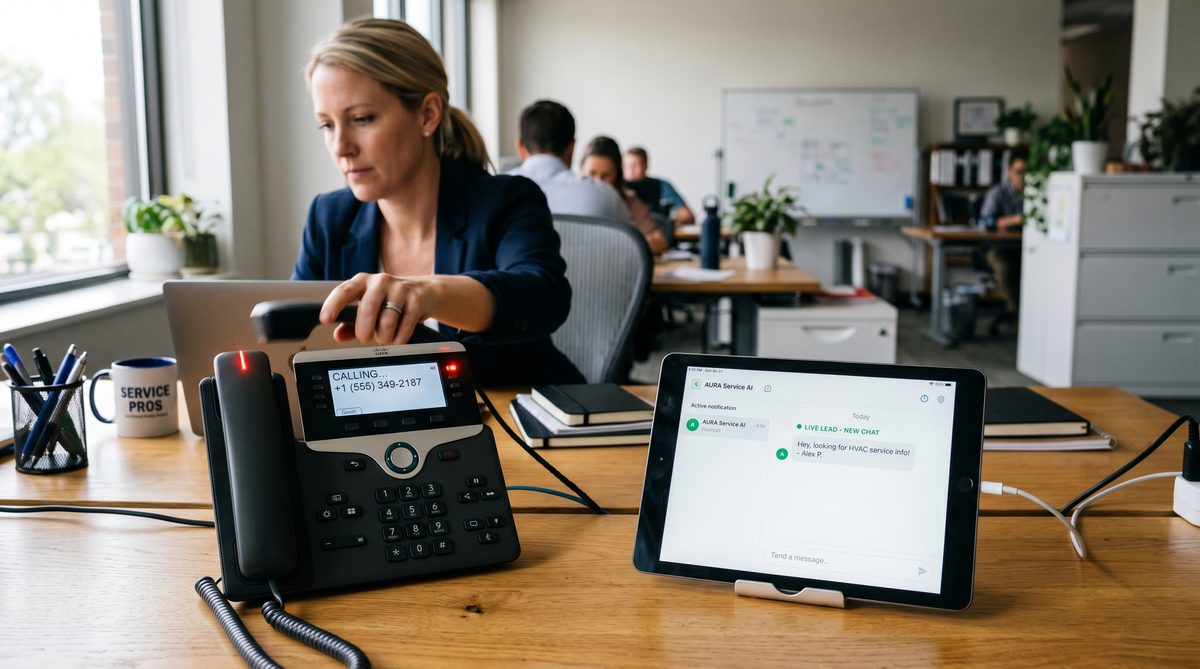
This is the watchstanding position. When the phone rings and your team cannot answer — which, statistically, is more than half the time — the AI voice agent answers within 60 seconds, qualifies the lead, and books the appointment.
Not voicemail. An actual conversation. The AI asks qualifying questions: What service do you need? Is this an emergency? What is your address? Are you available Thursday between 2 and 4 PM?
If it matches your criteria, it books directly into your calendar. If it is an emergency, it triggers an immediate dispatch alert to your phone. If it is outside your service area, it politely ends the conversation and logs the data.
CallSetter AI deploys in 48 hours, requires no code, integrates with ServiceTitan, Housecall Pro, Jobber, HubSpot, and GoHighLevel, and runs 24/7/365. Their pilot data shows a 25%+ increase in booked appointments from leads that previously went to voicemail. (Source: CallSetter AI)
Monthly cost: approximately $297 to $597 depending on volume. Annual cost of doing nothing: six figures in missed revenue.
Component 3: The Follow-Up Sequence
Not every lead books on the first contact. Some submit a form at 11 PM, sleep on it, and need a nudge at 8 AM. Some call, get your AI agent, and say “I’ll call back” — and never do.
The follow-up sequence catches these. Automated SMS and email within the first 60 minutes of lead submission. A second touch at 24 hours if no booking. A third touch at 72 hours. After that, move to a monthly nurture list.
Five touches covers 90% of convertible leads. Three touches covers approximately 70%. Most service businesses make one attempt and stop.
Build the sequence once. It runs without you. That is the operator-independent delivery system principle applied to your front door.
The 10 Most Common Lead Scenarios — And What the System Does With Each
Your AI response system needs to handle these without human intervention:
- Emergency call during business hours — AI answers, detects emergency keywords, dispatches alert, books soonest slot
- Emergency call after hours — Same sequence; emergency alert goes to on-call tech immediately
- General inquiry during business hours — AI qualifies, books estimate, sends confirmation SMS
- General inquiry after hours — AI qualifies, books next available slot, sends confirmation
- Repeat customer calling — CRM integration flags returning customer, AI greets by name, routes to priority queue
- Out-of-service-area call — AI politely declines, logs the inquiry, does not waste a booking slot
- Price shopper who will not commit — AI captures contact info, adds to nurture sequence
- Website form submission — Auto-SMS within 5 minutes with booking link; AI voice outbound call if no response in 10 minutes
- Google message or Yelp inquiry — Captured by intake layer, routed to same sequence as website form
- Voicemail (if someone bypasses the AI) — AI transcribes the voicemail, logs it, triggers follow-up sequence automatically
Every scenario has a defined procedure. No scenario relies on someone remembering to check a phone. That is the manual. That is how a nuclear plant runs — every casualty has a drill, every watchstander knows their station.
How to Measure the Revenue Impact
Do not wait 90 days to know if the system is working. Set up three measurements from day one.
Measurement 1: Response time average. Pull the time between lead submission and first contact. Your baseline is probably 4-24 hours. Your target is under 5 minutes for phone and under 10 minutes for web. Measure weekly.
Measurement 2: Booking rate by response time cohort. Segment your leads into four buckets: contacted in 0-5 minutes, 5-60 minutes, 1-6 hours, 6+ hours. Compare booking rates. The difference in that comparison is your proof of concept — and the mathematical case for doubling down on the system.
Measurement 3: Revenue per lead source. Once the intake layer is unified, you can finally compare Google versus Yelp versus referral versus direct website on an apples-to-apples basis. Some service businesses spend 70% of their ad budget on the channel producing 30% of their revenue. The data fixes that allocation once you can see it clearly.
This is Data’s DNA in production. Not dashboards for their own sake. Data that tells you exactly which lever to pull next.
The Right Tool Stack for a Business That Cannot Afford a Full CRM
You do not need Salesforce. Here is the operator-grade stack for a service business doing $300K to $1.5M per year:
- AI Voice Agent: CallSetter AI (callsetter.ai) — $297-$597/month. Handles inbound calls 24/7, books to your calendar, integrates with field service software.
- Unified Lead Intake + Follow-Up: Thryv AI Lead Flow (thryv.com) — captures all channels, AI lead scoring, automated follow-up sequences. Built specifically for service businesses across 50+ industries.
- Calendar: Google Calendar or whatever your field service platform uses. Both platforms above integrate directly.
- Optional CRM if scaling: GoHighLevel at $97/month gives you a full CRM, pipeline view, and automation builder once you hit the point where you need more visibility.
Total system cost: under $700/month. At a $400 average ticket and 20% conversion on previously missed leads, you need to recover 4 jobs per month to break even. Most service businesses recover 15 to 40.
FAQ
Q: What does the minimum viable 5-minute lead response system look like for a solo service operator?
A: Three components: an AI voice agent that answers your phone when you cannot (CallSetter AI deploys in 48 hours), a unified intake platform that captures web, Yelp, and Google leads into one queue (Thryv AI Lead Flow), and an automated SMS/email follow-up sequence that runs for 3 to 5 touches over 72 hours. Total cost is under $700/month. The system contacts every lead within 5 minutes without you touching a phone.
Q: How do you measure the revenue impact of improving lead response time from 24 hours to under 5 minutes?
A: Start with your current data: calls received per month, estimated miss rate, average ticket value, and conversion rate. A business receiving 200 calls per month at a 62% miss rate, $400 average ticket, and 20% conversion is leaking approximately $9,920/month. When the AI system captures 50% of those missed leads and books at a 15% conversion rate, that is approximately $4,500/month recovered — $54,000 per year — on a $700/month system. The InsideSales 2021 study confirms the 8x conversion differential between 5-minute and 24-hour response. Run the math against your own numbers.
Q: What is the correct AI tool stack for a service business that cannot afford a full CRM?
A: CallSetter AI for phone coverage ($297-$597/month). Thryv AI Lead Flow for multi-channel intake and follow-up automation. Google Calendar or your existing field service software (Jobber, Housecall Pro, ServiceTitan) for booking. Total under $700/month. You do not need a CRM until you are managing 50+ active leads per month. At that point, GoHighLevel at $97/month adds the pipeline visibility without the Salesforce overhead.
Q: Can this system handle emergency calls correctly, or will it frustrate customers who need immediate help?
A: Yes — if configured properly. CallSetter AI includes emergency detection that recognizes keywords like “no heat,” “flooding,” “gas leak,” and “no power” in real time and immediately dispatches an alert to your on-call line. The customer gets an instant acknowledgment and a confirmation that a tech will call back within minutes. This is faster than most human receptionists who would have to track down the on-call tech manually. The key is configuring your emergency protocols during onboarding — the system cannot prioritize what it does not know to look for.
Q: Will customers know they are talking to AI, and does it matter?
A: Some will know. Most will not. CallSetter AI’s pilot data shows zero negative customer feedback about the AI interaction across their initial deployments. What customers care about is speed and competence — being acknowledged immediately, having their information taken correctly, and getting a confirmed booking. An AI that does that in 60 seconds beats a human who calls back in 4 hours. Speed and accuracy matter. The medium is secondary. What matters is that someone — or something — answered.