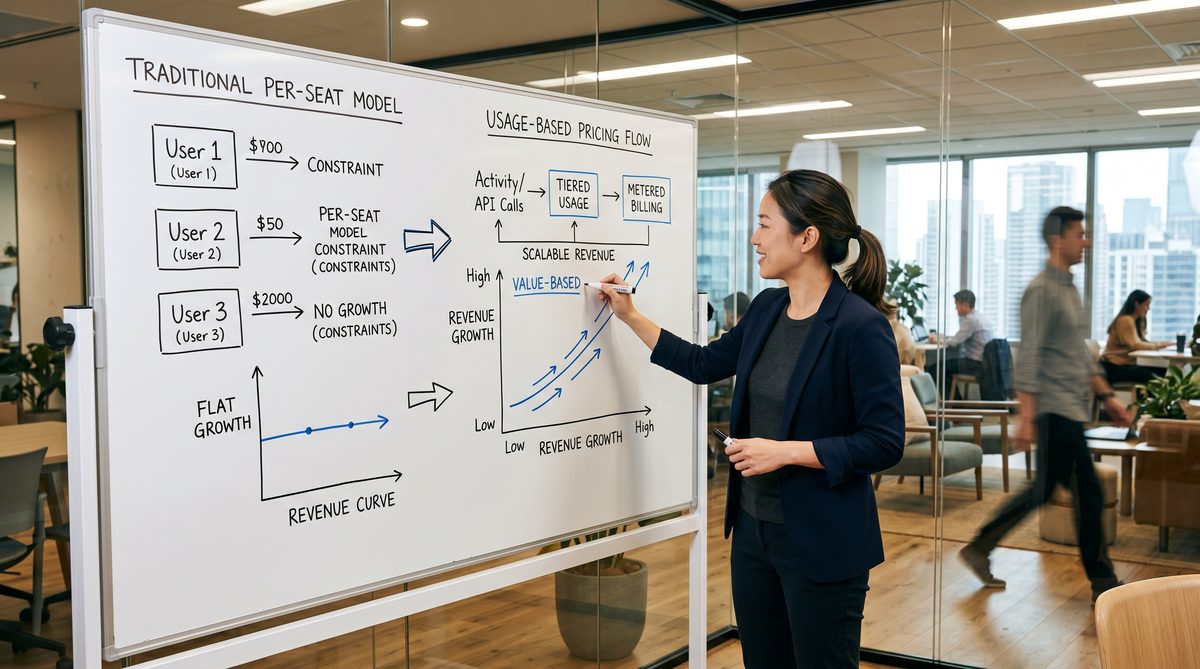
The Math That Kills Seat-Based Pricing
The per-seat SaaS model is not broken because it's old. It's broken because AI agents don't need seats. Deloitte predicts up to half of organizations will put 50% or more of digital transformation budgets toward AI automation in 2026. When an AI agent does the work of five humans, you don't need five Salesforce seats — you need one.
I've evaluated hundreds of SaaS businesses at Angel Investors Network. The ones that command premium multiples at exit aren't the ones with the most seats. They're the ones with pricing tied to customer outcomes. The math always wins. And right now, the math is pointing directly at the agentic economy.
This isn't theory. In February 2026, the market staged one of the most dramatic selloffs in software history. Approximately $285 billion vanished from SaaS valuations in 48 hours after Claude Cowork launched. Wall Street concluded that if one AI agent replaces five humans, then charging per headcount is economically nonsensical. The market doesn't accept nonsense.
Founders who restructure now — from seat-based to usage or outcome pricing — will capture exit premiums. Founders who wait will watch their multiples compress.
Why Seat-Based Models Die in the Agentic Era
Let's start with the structural problem. A per-seat license model assumes one seat equals one productive unit of work. That assumption held when seats meant humans. It collapses when agents enter the engine room.
Consider Salesforce's market dynamics. In early 2026, Atlassian reported its first-ever decline in enterprise seat counts. Not user growth slowing — seat count *declining*. Customers were replacing human reps with agents. They needed Salesforce licenses for the agents, sure, but not for the five reps whose work the agents now performed. That's the inflection point. That's when multiples start to compress.
Deloitte's research is unambiguous: the per-seat revenue share will drop from 21% to 15% by 2030. That's not speculation. That's installed base mathematics. Organizations are consolidating seat counts right now. Your customers are doing it. The ones paying you today will renegotiate during renewal.
The manual here is simple: founders who can't model outcome-based metrics will face margin compression within 18 months. It's damage control or it's death. You choose the compartment.
The Owner's Exit Engine: Restructuring Revenue
The Owner's Exit Engine demands one foundational question: is your revenue model defensible at a higher valuation?
Seat-based pricing is no longer defensible. Period. Not because there's something inherently wrong with recurring revenue — recurring revenue is an asset class. But because the unit economics of per-seat models collapse when your customers deploy agents instead of humans.
Here's the restructure playbook:
Step One: Anchor on the Outcome, Not the Seat
Start by asking: what does the customer actually care about? Not the seat count. Not the user count. The *outcome*.
If you build sales automation, the outcome isn't "sales rep seats." It's deals closed, pipeline velocity, win rate. If you build support software, it's resolution time, CSAT, tickets closed per dollar. If you build analytics, it's decisions made from data, revenue influenced by insights.
The shift is semantic but material. You're not selling a capacity unit (the seat). You're selling an *outcome proxy* — a metric that correlates with customer value.
Intercom made this move. They launched Fin, an AI support agent. The pricing model? $0.99 per resolved conversation. Zero resolution, zero charge. That's outcome-based pricing. The customer cares about resolved tickets. Intercom gets paid for delivering exactly that.
Salesforce launched Agentforce at $2 per conversation or $0.10 per standard action. Not per seat. Per action. That's the signal to watch.
Step Two: Model Revenue Impact Without Blowing Up ARR
This is where most founders get nervous. "If I shift to usage-based pricing, won't my current customers leave or renegotiate?"
The answer: maybe. But restructuring poorly kills you faster than restructuring. Here's the approach:
Run a cohort analysis on your current customers. Map their current seat count to an outcome metric. If you sell CRM software and a customer has 10 sales reps, estimate how many opportunities they're closing per rep per month. That's your baseline.
Now imagine they deploy an AI agent. Their rep count might drop to eight, but their opportunity conversion might rise 15%. They're now worth *more* to you under outcome-based pricing than they were under seat-based pricing.
This is the revenue bridge. Your current customers don't leave. They transition to a hybrid model: a fixed base fee (lower than their old subscription cost) plus variable outcome billing. The math works because their outcomes improve.
Hybrid models are the dominant transition state in 2025–2026. Gartner predicts that by 2030, at least 40% of enterprise SaaS spend will shift to usage, agent, or outcome-based pricing. That leaves a 4-year window for hybrid adoption. Use it.
Step Three: Choose Metrics That Compound Exit Valuation
Not all metrics are equal at exit. Here's what acquirers actually value:
Defensible metrics tie directly to customer ROI. Resolved issues. Pipeline influenced. Revenue attributed. These metrics improve with your product improvement, not with seat sprawl. Acquirers love defensible metrics because they signal operator-independent revenue. The customer isn't captive to headcount. They're captive to outcomes.
Weak metrics are soft proxies that don't correlate to customer ROI. API calls consumed. Data bytes processed. These metrics are volatile and don't anchor to customer P&L. Acquirers discount these heavily.
Hybrid metrics blend fixed and outcome components. A $5,000 monthly platform fee plus $0.05 per transaction. The fixed component provides revenue predictability (acquirers value this). The outcome component ties you to customer success (acquirers value this). This is the sweet spot for exit premium.
When you're modeling a restructure, the question isn't "which metric scales revenue fastest?" The question is "which metric compounds my exit multiple?" They're different questions.
Step Four: Build the Migration Playbook
Don't flip a switch. Migrate in cohorts.
Wave One (Months 1–3): New customers only. Launch your new outcome-based pricing to new ARR. Run it in parallel to your seat-based model. Measure, refine, document every conversion and churn scenario.
Wave Two (Months 4–9): Expansion accounts. Existing customers who are asking for new products or seat increases get the new pricing option. "You want to add five seats? Let's talk about a usage-based expansion instead." This captures incremental ARR on the new model without disrupting legacy revenue.
Wave Three (Month 10+): Legacy renewal cohorts. As customers renew, offer them an incentive to migrate. Maybe a 5% discount in year one if they switch to the new model. Offer white-glove transition support. Make migration low-friction.
During this playbook, watch your net revenue retention. If NRR stays flat or improves, you're on track. If NRR compresses, you've priced too aggressively. Adjust.
The goal is zero net ARR loss during restructure. Not zero revenue change — net ARR change. Some customers will churn. That's the cost of restructure. But your surviving base should pay you *more* under the new model, not less.
Real Examples: Who Made the Shift
Intercom restructured around outcome-based metrics. Their Fin AI agent charges per resolved conversation. They went from pure subscription to a hybrid model. Result: higher customer retention because customers win if Fin resolves conversations efficiently.
Datadog shifted to consumption-based pricing years ago. They don't charge per seat. They charge per byte ingested. That created an incentive alignment: Datadog makes more money when customers generate more data. That only works if your product is valuable *as data scales*. The metric matters.
Microsoft moved Teams toward a hybrid model. Base subscription for collaboration. Additional charges for advanced features and API consumption. Pure seat-based pricing couldn't sustain the company because seat-based doesn't reward feature innovation. Consumption-based does.
Snowflake's entire pricing is built on compute consumption, not seats. They charge per credit consumed. That model meant they could grow revenue with customer success, not with customer headcount. That defensibility earned them a $30 billion valuation at exit.
The Deloitte Prediction: Act Now
Deloitte is clear: organizations will allocate $1 out of every $2 in digital transformation budgets toward AI automation in 2026. That means AI agents are not a 2027 problem. They're a *now* problem.
Your customers are deploying agents today. If your pricing model is still structured around seats, your customers are renegotiating downward. You're not capturing the value creation. You're watching margin compression.
The ownership question is not "should I restructure?" The question is "do I restructure on my timeline or on Wall Street's timeline?" February 2026's $285 billion SaaS selloff answered that. The market restructures fast.
Funders who can model outcome-based revenue, demonstrate net revenue retention through the transition, and show cohort-level unit economics on the new model will attract capital. Founders clinging to seat-based models will face capital scarcity.
This is where the doctrine of "Capitalism creates value" manifests. Your pricing model either aligns your profit with customer success (capitalism). Or it misaligns them (extractive rent). One attracts capital. One doesn't.
Building Your Transition Timeline
The checklist is straightforward:
1. Month 1–2: Audit your current customer base. Map seat counts to outcome metrics. Identify your revenue bridge. Calculate the hybrid pricing structure that maintains current ARR while aligning to outcomes. 2. Month 3: Launch new pricing for new customers. Document every data point. 3. Month 4: Analyze early cohort performance. Adjust pricing if NRR is weak. 4. Month 5–6: Launch expansion pricing option for existing customers adding capacity. 5. Month 7–9: Build your migration incentive program. Create technical support for the transition. 6. Month 10+: Begin legacy renewal migrations. Track churn and NRR obsessively. 7. Month 12+: Assess exit readiness. If NRR improved, multiple compression is unlikely. If NRR degraded, you restructured too aggressively.
This isn't complexity for complexity's sake. This is standing watch on the engine room while the ship transitions to new fuel. You're not abandoning the engine. You're upgrading its architecture.
FAQ
Q: Won't my customers just renegotiate their ARR downward if I shift to outcome-based pricing?
Some will try. But here's the reality: if you restructure correctly, your outcome-based pricing captures *more* value than your old seat-based pricing, not less. A customer who was paying $50,000 annually for 10 seats might pay $30,000 fixed plus outcome fees that total $25,000 in year one. If their business scales, that outcome fee rises. You're not losing money. You're aligning it. And alignment means retention improves. The math has to win or it's not a real pricing model.
Q: How do I know which outcome metric to anchor on?
Start with your customer's P&L impact. What does your product influence on your customer's balance sheet? Revenue? Cost reduction? Efficiency gain? Whatever it is, that's your metric. Then verify it: interview 10 happy customers. Ask them what success metric they care about most. Whatever they say—align your pricing to that. If customers don't universally agree on the metric, you haven't found the right one yet. Keep looking. The right metric is obvious.
Q: What if outcome-based pricing makes my revenue too volatile?
Then you use a hybrid model. Fixed base fee covers your infrastructure costs. Outcome fees align you to customer success. The fixed component reduces volatility. The outcome component captures upside. This is why hybrid pricing dominates in 2025–2026. It balances your need for revenue predictability with your customer's need for outcome alignment. It's the professional transition state.
Q: How do I handle customers who refuse to migrate from per-seat pricing?
You grandfather them. Set an end-of-life date on your old pricing. Communicate it clearly in advance. Most will migrate when facing the alternative. For the holdouts, grandfather them at current pricing through their contract term. Then they churn or migrate at renewal. This is the cost of transition. It's better than slow death from structural misalignment.