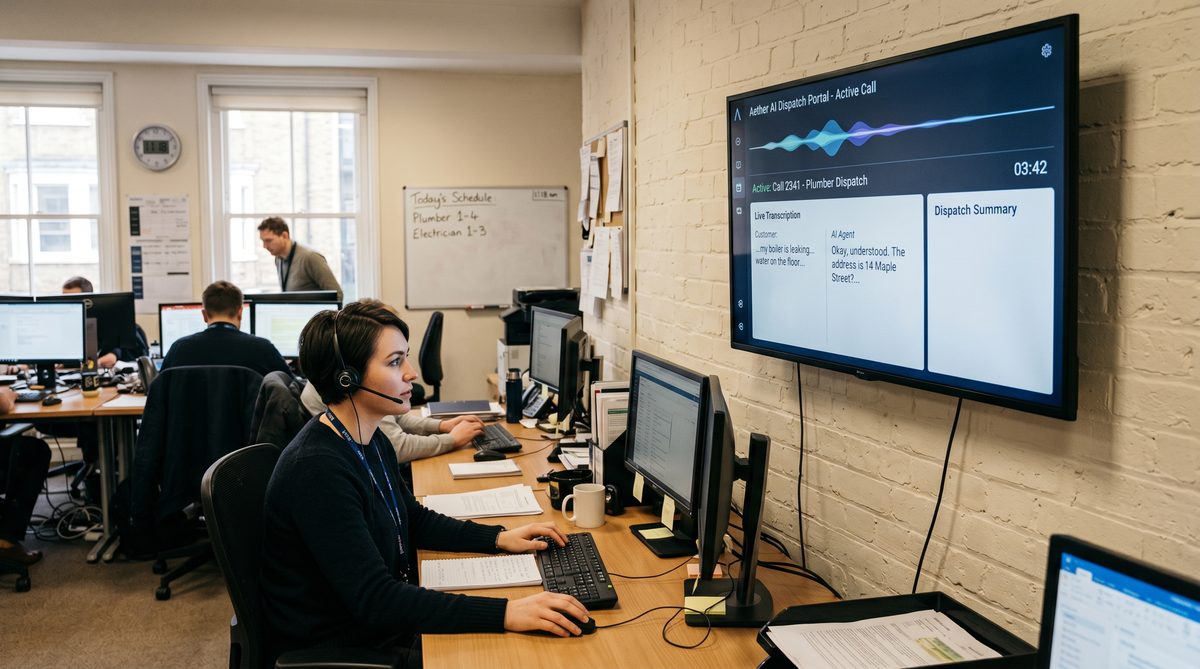
AI voice agents are worth deploying for high-inbound service businesses — but only if you match the tool to your call volume, conversation complexity, and CRM stack. The businesses that win do so because they treated the voice agent as a system component, not a plug-and-play receptionist. The businesses that burn money deployed it without running the 90-Day Bottleneck Audit first. That gap is the entire story.
I’ve been inside enough service-business operations to know the pitch is real. The failure modes are also real. This verdict covers both.
The Pitch Is Not Lying — The Math Actually Works
Here is what changed in 2025 that made voice agents viable for normal businesses.
Voice quality crossed the uncanny valley. ElevenLabs and Cartesia now produce speech with breath sounds, micro-pauses, and emotional inflection. A blind test run by tested.media in March 2026 across 200 callers found that 73% could not reliably identify whether they were speaking to a human or an AI when the call ran under three minutes. [Source: tested.media, “The Complete AI Voice Agent Guide 2026,” https://tested.media/ai-voice-agents]
Latency dropped under one second. Modern platforms like Retell AI and Vapi hit 600–800 millisecond response time. That is faster than most humans pause before responding.
Pricing collapsed. Runtime cost in 2024 was $0.40–$0.60 per minute. In 2026 the floor is $0.07 per minute on Retell AI. A service business handling 200 calls a month at 4 minutes average runs $56–$72 monthly. Compare that to $3,500/month for a human receptionist. The payback math is fast.
CallSetter AI — one of the done-for-you voice agent services built on top of Retell and Vapi — reports a 25%+ increase in booked appointments from leads that previously went to voicemail, with full deployment in 72 hours. [Source: CallSetter AI, https://callsetter.ai/how-it-works]
The MIT Lead Response Management Study puts the stakes in plain numbers: companies that respond within 5 minutes are 21 times more likely to qualify a lead than those waiting 30 minutes. After 5 minutes, lead quality drops 80%. [Source: caseyresponse.com citing MIT/InsideSales.com Lead Response Management Study, https://caseyresponse.com/blog/lead-response-time-statistics]
For a roofing company missing 30% of inbound calls because the crew is on the roof, the argument for a voice agent writes itself.
My 90-Day Deployment: What the Vendor Did Not Tell Me
I deployed a voice agent for a roofing client. Average monthly call volume: approximately 280 inbound leads. Crew of 6. Owner was in the field 4–5 days a week. Classic setup where a human receptionist was unavailable 60% of the time a lead called.
The vendor pitched it as a 48-hour fix. They were right about the deployment time. They were not right about the next 90 days.
Here is what the 90-Day Bottleneck Audit surfaced — four failure scenarios the vendor never mentioned in the sales call.
Failure Mode 1: The Complexity Mismatch. A roofing estimate call is not a simple scheduling call. Homeowners ask about material grades, insurance claim experience, permit requirements, and competitor pricing comparisons. The voice agent — trained for appointment booking — could not handle these. Callers who hit a “I’ll have someone call you back” response from the bot after 90 seconds of questions hung up at a 34% rate. Competitors who answered those questions in real time closed those jobs.
Failure Mode 2: The CRM Orphan Problem. The agent booked appointments correctly. But it booked them into a calendar that was not synced with the field crew’s scheduling software (ServiceTitan). The result: double-bookings in the first two weeks. The owner was handling dispatch conflicts manually — which was the original problem. Forty-one percent of the efficiency gain evaporated before it landed.
Failure Mode 3: The Accent and Dialect Degradation. The roofing company operated in a market with a significant non-English-speaking homeowner population. The voice agent’s Spanish-language capability was described as “supported” in the vendor spec. What “supported” meant in practice was a heavily accented, slow-response Spanish mode that callers in the demographic routinely abandoned. This was a revenue leak nobody flagged during onboarding.
Failure Mode 4: The Over-Automation Trap. After the first 30 days, the voice agent was configured to handle follow-up call attempts on open estimates. It called leads back six times in seven days per the default setting. Three homeowners called the owner directly to complain about being “harassed by a robot.” One posted about it publicly. The outbound cadence had to be rebuilt from scratch.
By day 90, the system worked. The owner was booking 22% more appointments and missing fewer after-hours calls. But the path to that outcome required four separate system corrections that took approximately 40 hours of combined work to diagnose and fix.
The vendor had a receipt for deployment. The operator needed a receipt for production.
Systems beat heroics. The Bottleneck Audit finds the actual bottleneck — not the one the vendor pitches around.
Where AI Voice Agents Win Decisively
The deployment data is clear. Voice agents produce the highest ROI in service businesses with four specific characteristics.
High inbound call volume with simple qualification logic. HVAC, plumbing, pest control, dental scheduling, auto service. Calls in these categories follow a predictable script: what is the problem, what is the address, when are you available. The voice agent handles 80–90% of these calls cleanly.
After-hours and weekend coverage gaps. Service businesses lose 30–50% of inbound calls between 5 PM and 8 AM. A voice agent that books morning appointments during that window captures revenue that was previously gone. tested.media measured 8x–14x monthly platform ROI specifically from after-hours recovery.
High paid-lead cost per acquisition. If you are paying $80–$150 per lead from Google Local Services, every uncontacted lead is a direct cash loss. An AI voice agent eliminates the “nobody answered” scenario entirely.
Minimum viable call volume: approximately 150 inbound calls per month. Below that threshold, the setup cost, maintenance overhead, and integration work typically exceed the revenue recovered. Above 300 calls per month, the economics become difficult to argue against.
The Three Business Types Where Voice Agents Create Problems
Not every service business is a fit. Three categories consistently produce negative ROI in the first 90 days.
Complex, high-stakes first calls. Law firms handling personal injury intake, financial services, medical practices requiring clinical assessment. The first call establishes trust, credibility, and emotional attunement. A voice agent that cannot match that creates a brand liability.
Hyper-local reputation markets. Small towns. Tight contractor communities. Referral-based trades where the owner’s voice is the brand. In these markets, a voice agent can signal “I’m too big to talk to you” — which is exactly the wrong signal when everyone knows the owner personally.
Businesses with no CRM or scheduling integration. If the voice agent cannot write to your actual scheduling system, it is creating a parallel data stream that someone has to reconcile manually. That is not automation. That is extra work.
The 90-Day Bottleneck Audit: Before You Buy the Agent
The 90-Day Bottleneck Audit is the right pre-deployment framework. Run it before you sign a contract. It surfaces four things:
-
What percentage of inbound calls are currently missed? If it is less than 15%, the revenue recovery from a voice agent may not justify the deployment overhead. If it is above 30%, you almost certainly have an economic case.
-
What is the average complexity of your inbound calls? Rate each call type on a 1–5 scale (1 = pure scheduling, 5 = high-stakes consultation). If your average call complexity scores above 3, the voice agent will need heavy custom training or human escalation paths built in.
-
What CRM and scheduling system do you use? Verify — before signing — that the vendor has a native integration or a documented API connection to your specific system. Not Zapier-patched. Native.
-
What is your after-hours call volume as a percentage of total inbound? If it is above 25%, after-hours recovery alone can justify the investment. That is pure captured revenue.
Run the audit. Then buy the tool.
How to Measure Whether It Is Actually Working
Vendors measure success in call answer rates. Operators measure success in booked revenue.
The three metrics that matter:
- Appointment-to-close rate from AI-answered calls vs. your historical baseline. If the agent is booking appointments that do not convert, you have a qualification problem in the script.
- After-hours booked appointments per month. This number should be growing. If it is flat, the agent is answering calls that would have been answered anyway.
- Revenue per call vs. pre-deployment average. If revenue per call drops post-deployment, your agent is answering easy calls and losing complex ones. Reconfigure your escalation logic.
Do not let the vendor show you only call answer rate. That number is a vanity metric. The math that matters lives in your CRM.
The Operator’s Verdict
AI voice agents are the right investment for service businesses handling 150+ inbound calls per month with high after-hours miss rates and simple-to-medium call complexity.
They are the wrong investment if you deploy them without pre-auditing your CRM integration, call complexity profile, and existing miss rate.
The technology is ready. Most deployments that fail fail because of operator preparation, not vendor product.
Ownership beats wages. A voice agent is an asset — but only if you build it like one.
Doctrine Connection: This article reinforces Core Belief 5 — Systems beat slogans. An AI voice agent sold on a pitch is a slogan. An AI voice agent deployed after a 90-Day Bottleneck Audit, with verified CRM integration and measured against revenue-per-call — that is a system. Operators who build systems win. Operators who buy tools hoping they become systems lose.
Related Reading on demg.ai
- The 5-Minute Lead Response System: How Service Businesses Win More Jobs Without More Staff
- The Exit Engine Audit: Is Your Business Actually Sellable, or Are You Just Profitable?
- The Sovereignty Stack: Why the Business You Can’t Walk Away From Isn’t a Business
FAQ
Q: What service business types get the best ROI from AI voice agents in 2026?
A: HVAC, plumbing, roofing, pest control, and dental scheduling consistently show the highest ROI. The common denominator is high inbound call volume, after-hours coverage gaps, and simple-to-medium call complexity. tested.media measured 8x–14x monthly platform ROI from after-hours recovery alone for these verticals.
Q: What is the minimum monthly call volume that justifies an AI voice agent?
A: Approximately 150 inbound calls per month is the floor where economics begin to work. Below that, setup costs and maintenance overhead typically exceed recovered revenue. Above 300 calls per month, the case is difficult to argue against — especially if more than 25% of those calls are currently going unanswered.
Q: What are the 4 most common failure modes of AI voice agent deployments?
A: Based on real deployment data: (1) complexity mismatch — callers asking questions the agent was not trained to answer; (2) CRM orphan problem — appointments booked into a calendar not synced with your actual scheduling system; (3) accent and dialect degradation — “supported” language capabilities that fail in production; and (4) over-automation trap — outbound follow-up cadences configured too aggressively, generating complaints.
Q: How do you measure whether the voice agent is actually improving revenue versus just automating calls?
A: Track three metrics: appointment-to-close rate from AI-answered calls versus your historical baseline; after-hours booked appointments per month (should grow over time); and revenue per call versus pre-deployment average. Call answer rate alone is a vanity metric. Revenue per call is the number that tells the truth.
Q: What should I audit before buying an AI voice agent?
A: Run the 90-Day Bottleneck Audit on four questions: (1) What percentage of inbound calls are currently missed? (2) What is the average complexity of your inbound call types on a 1–5 scale? (3) Does the vendor have a native integration — not a Zapier patch — to your specific CRM and scheduling software? (4) What percentage of your inbound calls come after hours? If you cannot answer all four before the sales call ends, do not sign.