AI agents are not coming for your agency. They are already here, running inside your clients’ enterprise software stacks, handling the coordination work your account managers are doing manually right now. The smart move is not resistance — it is redesign. Agencies that rebuild their delivery model around AI agents will win more business, run leaner, and produce better work. Agencies that do not will find themselves competing for contracts that barely cover overhead.
The Coordination Layer Is Gone
Account management in most agencies is 70% coordination and 30% thinking. Status updates. Campaign reports. Brief generation. Pulling screenshots and CPMs into a deck that nobody reads until the meeting starts. Chasing approvals. Monitoring ad spend at midnight because the budget is about to blow and no one set an alert.
AI agents handle all of that now. Not chatbots — do not confuse the two. A chatbot answers questions. An AI agent takes action. It checks the media plan, identifies a performance anomaly, adjusts the bid strategy, logs the change, and sends the client a summary — without a human touching it.
Gartner forecasts that 40% of enterprise applications will embed task-specific AI agents by end of 2026, up from less than 5% in 2025. That is not a trend to watch. That is a structural shift already in motion. The global AI agents market is projected at $10.9 billion in 2026, growing at a CAGR above 45% through 2030, according to multiple analyst firms including MarketsandMarkets and Grand View Research.
The coordination layer that justified mid-level account manager salaries is being automated out of existence. Agencies that are still pricing that coordination layer into their retainers are selling a service that clients can increasingly get from their own software.
What Jeff Learned Building DEMG
When I was building DEMG, I ran into the same problem every agency founder hits: the delivery depends on individual people remembering things. A campaign goes sideways because the person who knew the client’s seasonality calendar is out sick. A client gets a status update that contradicts what they were told last week because two people are tracking the account in two different spreadsheets. You cannot build a scalable agency on memory. Memory fails. Memory walks out the door when your best account manager takes a recruiter’s call.
I spent years watching agencies — including my own at various stages — operate on tribal knowledge. No written doctrine. No system that outlasts the individual. That is not a business. That is a collection of people improvising in coordinated chaos.
The Navy taught me something different. On a submarine, you do not trust memory. You trust the system. Every watchstanding procedure, every casualty drill, every damage control protocol is written down, rehearsed, and executed the same way every time — regardless of who is standing the watch. The watch station does not care if it is your first week or your tenth year. The system runs.
Agencies that adopt AI agents are not just automating tasks. They are building the equivalent of a submarine’s watch doctrine. The system handles the watch. People handle the judgment calls.
The ATLAS Model for Growth
The ATLAS Model for Growth is the framework I use to evaluate whether an agency is building a scalable asset or a people-dependent liability. It stands for:
- Automate the coordination layer
- Train agents on your client’s data and context
- Limit human time to high-judgment work only
- Audit agent outputs on a defined cadence
- Scale the model across clients without adding headcount
Most agencies are stuck at zero. They have not automated anything. They have hired more account managers to manage more clients. That is not growth — that is a payroll problem wearing a revenue costume.
The ATLAS Model starts with an honest inventory. What tasks in your agency are coordination? What tasks are judgment? Draw a hard line. Everything on the coordination side is a candidate for agent automation. Everything on the judgment side is where your people should spend 100% of their time.
What AI Agents Handle Now
Here is the current state. These are not future capabilities — they are live, deployable today.
Client reporting. AI agents pull performance data from ad platforms, SEO tools, and analytics dashboards. They format it into reports, flag anomalies, and deliver summaries to clients on a defined schedule. An account manager does not touch this unless the data tells a story that requires human interpretation.
Campaign monitoring. Agents watch for budget pacing issues, CTR drops, quality score changes, and audience fatigue. They alert humans when thresholds are crossed and, in more advanced configurations, take corrective action automatically.
Brief generation. Creative briefs pull from client brand guidelines, past campaign performance, and current objectives. An agent can draft a brief in minutes. A strategist reviews and sharpens it. This cuts brief production time by 60-80% in agencies that have implemented it.
Status updates. Agents log meeting notes, extract action items, and push updates to project management systems and client portals. The client sees progress in real time. The account manager stops writing update emails.
Media plan adjustments. When a channel underperforms, an agent flags the delta, proposes a reallocation, and surfaces it for human approval. The account manager makes the call. The agent does the math and the documentation.
In April 2026, SS&C Blue Prism formally unveiled WorkHQ, its enterprise agentic automation platform, at a live global broadcast from Nasdaq. WorkHQ orchestrates AI agents, digital workers, APIs, and human decision-making in a single governed environment — exactly the kind of infrastructure enterprise clients are now buying to replace coordination work they were paying agencies to do manually.
What Account Managers Should Do Instead
The account manager role does not disappear. It evolves — and the version that survives is worth significantly more than the coordinator version.
Strategy. Someone has to decide what the agency is trying to accomplish for the client, why, and in what order. That requires understanding the client’s business model, their competitive position, their customer psychology, and their internal politics. No agent knows that a client’s CFO hates brand spend and will pull the budget at the first sign of weak lead volume. A good account manager does.
Relationship. Clients do not renew contracts with software. They renew contracts with people they trust. An account manager who calls before the client has a problem, who shows up with a perspective the client has not considered, who tells the client hard truths without losing the relationship — that person is irreplaceable. An agent cannot build that.
Creative direction. Briefing creative teams, reviewing concepts against brand and strategy, making judgment calls on what goes to client and what does not — this is high-judgment work that requires taste, context, and accountability. These are not automatable.
The agencies winning right now are the ones restructuring account management so that one senior strategist, supported by AI agents, can manage three to five times the client load they could manage before — at higher quality and higher margins.
How to Structure the Hybrid Model
This is the build sequence.
Step 1: Audit your current task inventory. List every recurring task your account teams perform. Tag each as coordination or judgment. You will find that 60-70% of the task list is coordination.
Step 2: Select an agent stack. You need an orchestration layer (something like Make, Zapier AI, or a custom build on an LLM API), data connectors to your ad platforms and analytics tools, and a delivery mechanism for client-facing outputs. Do not overbuild this. Start narrow.
Step 3: Automate one task type completely. Pick the highest-volume coordination task — usually reporting or status updates — and build an agent to handle it end-to-end. Measure the time saved. Use that number to justify the next build.
Step 4: Redefine the account manager role. Write a new job description. Make it explicit: this role does not write status updates, pull reports, or generate briefs. This role owns the client relationship, the strategic direction, and the creative judgment. Hold people accountable to that definition.
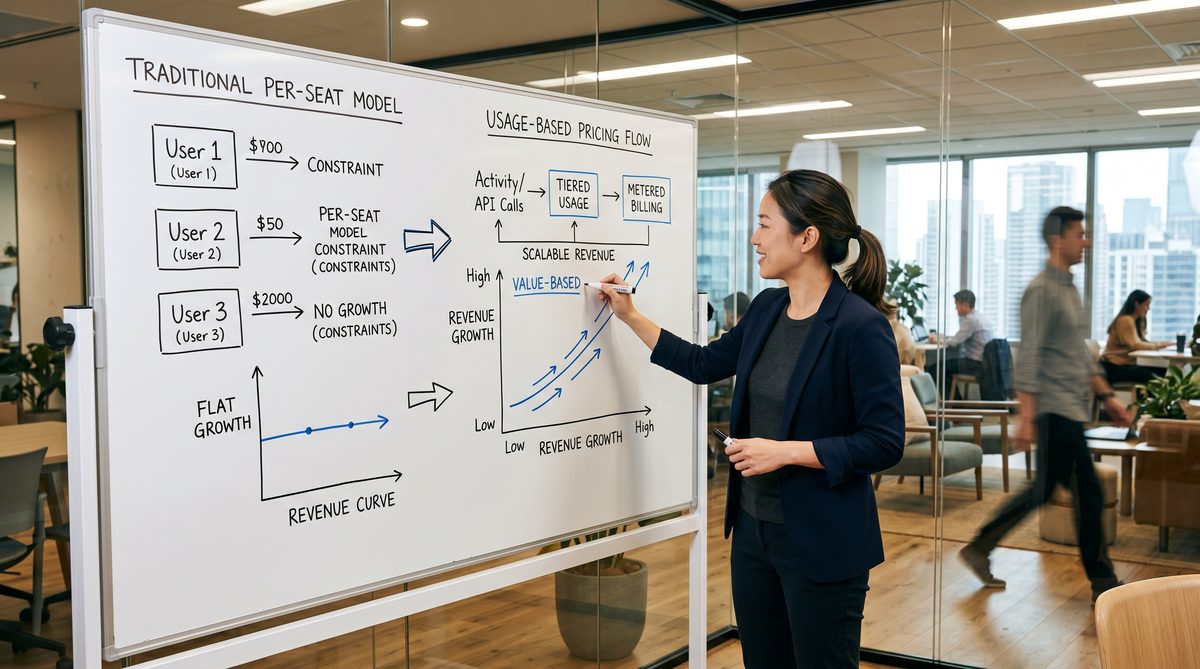
Step 5: Price the model correctly. Agencies that automate coordination but still price like they are doing it manually are leaving margin on the table. Value-based pricing, tied to client outcomes, is the right model for an AI-augmented delivery operation.
The Build-to-Sell Calculus
Here is the capital language version of this argument. An agency whose delivery depends on individual people remembering things is not an acquirable asset — it is a services business that trades at a low multiple and requires key-man clauses in every deal.
An agency with documented systems, automated coordination, and a repeatable delivery model is a different kind of balance sheet. It has sovereignty. The owner is not the bottleneck. The systems run without the founder in the room. That agency exits at a higher multiple, attracts institutional buyers, and gives the founder actual liquidity.
AI agents are not just a productivity play. They are a valuation play. Every task you automate is one more proof point that your agency is a system, not a personality. Systems beat personalities at the exit table every time.
FAQ
Q: Are AI agents the same as chatbots? No. A chatbot responds to questions. An AI agent completes tasks autonomously — pulling data, making decisions within defined parameters, taking action, and reporting back. The distinction matters when you are evaluating tools and setting client expectations.
Q: Will clients resist AI-driven account management? Most clients care about outcomes, not process. If their reports are accurate, their campaigns are performing, and their account manager is calling with strategic insight instead of status updates, they will not object. Transparency about how you use AI is good practice. Leading with it as a pitch point is not necessary.
Q: How much does it cost to build an AI agent layer for an agency? It depends on your current tech stack and the complexity of your workflows. A functional reporting agent can be built for under $500/month in tooling costs. A full coordination layer across reporting, monitoring, and brief generation is a meaningful build project — but the ROI against account manager time is typically 10:1 or better within the first year.
Q: What if my account managers resist the change? The account managers who resist are the ones whose value is tied entirely to coordination tasks. The ones whose value is tied to relationships, strategy, and judgment will welcome it. You will find out quickly which type you have.
Q: How do we maintain quality control on agent outputs? Build an audit cadence into your delivery model. Every agent output that goes to a client should pass through a human checkpoint until you have enough data to trust the output quality. Define error thresholds. Audit a sample of outputs weekly. Treat it like quality assurance in a manufacturing operation — systematic, not occasional.
Doctrine Connection
Systems beat slogans.
That is a line we use at DEMG, and it applies here with precision. Your agency’s brand promise, your culture deck, your values statement — none of it means anything if your delivery depends on a person remembering to send a report on Thursday. The system runs the watch or the watch goes unmanned. Build the system. Staff the judgment. Let agents handle everything in between.
Sources
- Gartner Predicts 40% of Enterprise Apps Will Feature Task-Specific AI Agents by 2026
- AI Agents Market worth $52.62 billion by 2030 — MarketsandMarkets
- SS&C Unveils WorkHQ to Power Enterprise Agentic Automation — Business Wire
- SS&C Blue Prism Launches WorkHQ for Enterprise Agentic Orchestration — Developer Tech News
- Enterprise AI Agents Adoption Statistics 2026 — DemandSage
- AI Agents Market to Grow 43.3% Annually Through 2030 — GlobeNewswire