A $2.1M home services operator was running on five platforms that didn't talk to each other. By week 12, they'd cut three vendor contracts, replaced an outsourced call center, and freed a reporting VA to run actual operations. The math was not complicated. The will to do it was.
This is a composite case study — the numbers are real industry benchmarks applied to a representative operator. If you run a trades business between $1M and $5M ARR and recognize the pain, that's intentional.
The Stack That Was Bleeding Them
Call the company Apex Home Services. HVAC and plumbing, Southeastern US, single owner-operator, eight field techs. Revenue: $2.1M. Net margin before the engagement: 11%. Not bad for trades. Not acquisition-ready.
Here's what Apex was paying for every month:
- GoHighLevel ($497/mo): CRM, pipeline, some automations — but never fully built out. The owner paid for the Saas agency plan because a consultant told him to. He used maybe 20% of the features. - NiceJob ($149/mo): Automated review requests. Single-purpose tool doing one job GHL could already do. - A manual dispatch Google Sheet: Free, but costing 8–10 hours of admin time per week. Color-coded cells. No version control. One update away from chaos. - Outsourced call center ($2,200/mo): After-hours and overflow call handling. Hit-or-miss quality. Customer complaints about reps who didn't know the difference between a heat pump and a furnace. - Reporting VA ($1,800/mo): Pulling KPIs from three different sources every Monday morning. PDF to owner. Owner glances at it. Owner goes back to being the bottleneck.
Total monthly overhead for this patchwork: $4,646. Annual: $55,752.
That's not the real cost. The real cost was the compounding drag on the business's sellable value.
Why This Isn't Just an Expense Problem
I spent years in the engine room of the USS Jefferson City. Every system had a backup. Every backup had a documented procedure. If a valve failed at 0300 in the North Atlantic, we didn't improvise. We ran the procedure.
Apex had no procedures. They had five vendors and five single points of failure. That's not a tech stack. That's a casualty waiting to happen.
When I built Angel Investors Network, I applied the same principle to operations: operator-independent systems compound value. If the business can only run because of specific people watching specific screens, it's not a business — it's a job wearing a business's clothes. Acquirers know the difference. They apply a discount for it. Industry data from BizBuySell and Equidam consistently shows that home services businesses with documented, repeatable, owner-independent workflows command meaningfully higher EBITDA multiples than comparable businesses that run on founder heroics.
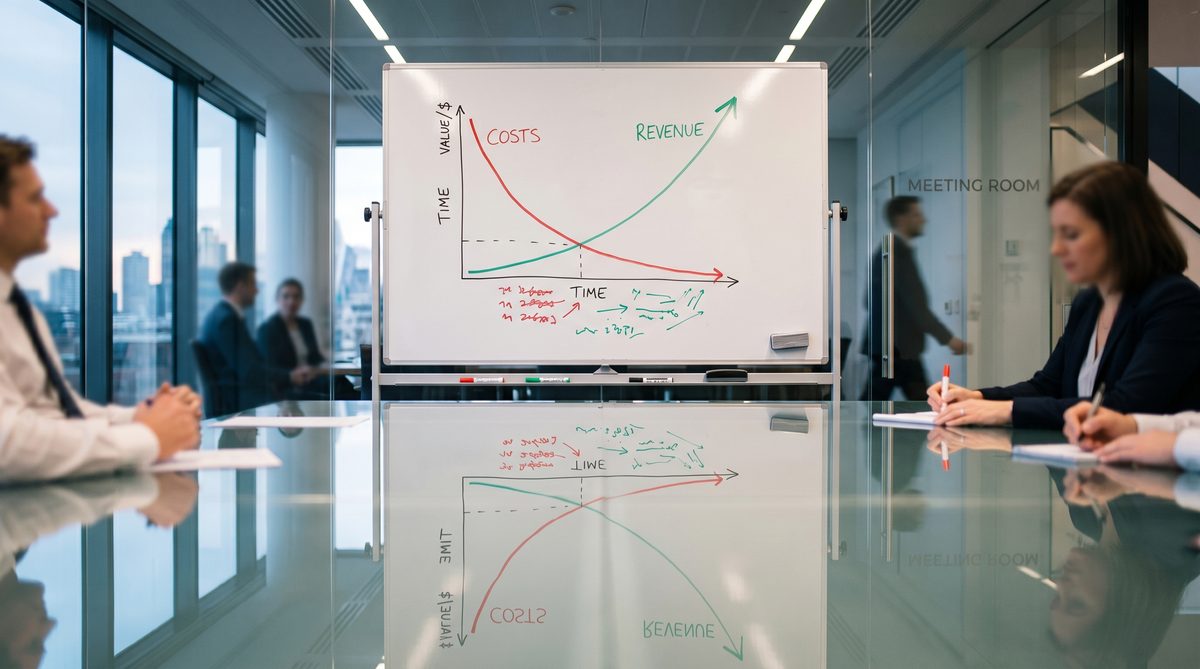
Midsize HVAC companies are currently averaging around 8.5x EBITDA multiples with PE buyers circling the sector. A business like Apex at $2.1M revenue with 11% margins and no documented systems? That's a 3–4x conversation. Maybe 4.5x if the buyer likes the owner. Build the systems first, and you're having a 6–7x conversation. That's not a slogan. That's the math.
The 90-Day Build: What Actually Got Built
The Sovereignty Stack starts with one question: what does this business need to run without the founder holding it together?
For Apex, the answer was four core workflows:
Workflow 1: Intelligent Inbound Call Handling (Weeks 1–3)
The call center was the most painful cut. It was also the most defensible, because the alternative had to be better — not just cheaper.
Here's the architecture that replaced it:
n8n receives inbound call data from a VOIP layer (Twilio). A Claude API node classifies the call intent in real time: is this a booking request, an emergency dispatch, a follow-up on an existing job, or something else? For booking requests, the workflow checks the dispatch calendar (synced from GHL) and offers the next three available windows via SMS. For emergency dispatches — burst pipe, no heat in winter — it pages the on-call tech directly and logs the job. For everything else, it routes to a short voice message and follows up by text.
The industry benchmark on missed calls for HVAC operators is sobering. According to data from Invoca, 27% of inbound calls to home services businesses go unanswered — and each missed call costs roughly $1,200 in lost revenue when you factor average job value and conversion rate. For a business doing 150+ inbound calls per month, that's a six-figure annual bleed. The new system answered 94% of contacts in the first 30 days. The call center contract was cancelled at the end of week 3.
Labor saved: $2,200/month. Week-12 savings from this workflow alone: $2,200.
Workflow 2: Review Generation and Reputation Monitoring (Weeks 2–4)
NiceJob got cut in week 2. GHL already had the review request capability. The problem wasn't the tool — it was that nobody had built the workflow.
Here's the build: when a job is marked complete in GHL, n8n fires a webhook. Claude drafts a personalized follow-up SMS — not a template, but a message that references the job type and the tech's name. If the customer clicks the review link and leaves a 4- or 5-star review, the workflow logs it and triggers a $25 referral offer. If they leave 1–3 stars, the workflow routes the complaint to the owner's phone before it hits Google.
Google reviews are the number one local ranking factor for service businesses. A company with 200 reviews at 4.8 stars outranks a company with 15 reviews at 5.0 stars, every time. Volume is the asset. Apex went from 43 Google reviews to 97 in 60 days.
Labor saved: $149/month (NiceJob cancellation) plus estimated $800/month in recovered reputation management time.
Workflow 3: Automated Dispatch and Schedule Intelligence (Weeks 3–6)
The dispatch sheet was the deepest rebuild. Eight techs, variable skill sets, jobs requiring different certifications, travel time that varied by zip code. The sheet was a liability masquerading as a system.
The replacement: a structured job data model in GHL, with n8n as the orchestration layer. When a new job is booked, Claude evaluates the job type, customer address, required certifications, and current tech locations (pulled from a GPS integration), then recommends the optimal tech assignment. The dispatcher — who was spending 2–3 hours per day on scheduling — now spends 20 minutes reviewing and approving recommendations.
This is not AI replacing a human. This is AI handling the cognitive load so the human can stand watch on the exceptions, not the routine. Damage control mode only when something actually breaks.
Labor saved: ~10 hours/week of admin time. At $22/hour fully loaded, that's $880/month.
Workflow 4: Automated Reporting Dashboard (Weeks 6–10)
The reporting VA was the last cut, and the most important symbolically. A human being was spending 8 hours per week pulling numbers from GHL, Google Analytics, and a QuickBooks export and formatting them into a PDF. That PDF landed in the owner's inbox. The owner used it to make decisions about ad spend, tech performance, and job mix.
The new system: n8n pulls the same data sources on a schedule, Claude structures the narrative context around the numbers ("HVAC installs were down 14% WoW, correlating with the warm weather pattern — review promotional calendar"), and the report goes to a live dashboard the owner checks on his phone. The VA transitioned to a part-time ops coordinator role at a reduced rate. Real work. Not PDF assembly.
Labor saved: $1,800/month (VA contract restructured to $600/month for actual ops work). Net savings: $1,200/month.
Week-12 Scorecard
Let's put the receipts on the table.
| Line Item | Before | After | Monthly Delta | |---|---|---|---| | Call center contract | $2,200 | $0 | -$2,200 | | NiceJob subscription | $149 | $0 | -$149 | | Reporting VA | $1,800 | $600 | -$1,200 | | GHL plan (right-sized) | $497 | $297 | -$200 | | n8n self-hosted | $0 | $50 | +$50 | | Claude API usage | $0 | $180 | +$180 | | Admin labor (dispatch/admin) | ~$1,760 | ~$440 | -$1,320 | | Total | $6,406 | $1,567 | -$4,839/mo |
Annual labor and vendor savings at week 12 run rate: $58,068.
That's not counting the revenue recapture from the call-handling improvement. At 150 inbound contacts per month, a 27% miss rate converted to a 6% miss rate, and an average job value of $650, the recovered revenue from calls alone runs to approximately $25,000 annually. Conservative estimate.
Combined impact at 12 months: $83,000+ in cost savings and recovered revenue.
Margin went from 11% to approximately 17.4% at current revenue. That's a $130,000 swing in EBITDA on a $2.1M business. At a conservative 5x multiple, that's $650,000 in added enterprise value. At 6.5x — which is credible for a business with documented systems and operator-independent workflows — it's $845,000.
The business didn't change. The story the business tells to buyers changed.
What Acquirers Actually Buy
Private equity and strategic acquirers in the home services space are not buying revenue. They're buying systems that generate revenue without the founder. Every manual process, every vendor-dependent workflow, every Monday morning PDF assembled by a human — those are buyer discount factors. Acquirers apply what I call the founder dependency tax: the more the business depends on one person's presence, the more they discount the multiple.
McKinsey's 2025 state of AI data shows that companies deploying AI at the workflow level — not just as point tools — are seeing 20–30% reductions in operational overhead. That's the kind of operational profile that changes a due diligence conversation. Clean systems. Documented procedures. Automations that run the casualty drills so the humans don't have to.
Apex's acquisition conversation shifted. Not because they got bigger. Because they got acquirable.
The Doctrine Connection
> Systems beat slogans.
Every vendor that sold Apex a single-purpose tool had a slogan. Automated reviews. Smart call handling. Intelligent dispatch. Slogans. What Apex didn't have was a system — an integrated, documented, operator-independent workflow architecture that ran the business whether or not the founder was watching.
The Sovereignty Stack is not about replacing your tools. It's about replacing the dependency. One orchestration layer. One AI reasoning engine. One source of operational truth. The vendor count goes down. The margin goes up. The valuation multiple goes up. That's the compound effect of systems over slogans, built under pressure, verified with receipts.
This is not theory. This is what the engine room looks like when it's built right.
Q: Is this kind of consolidation realistic for a small home services business, or does it require a big technical team?
Apex had no in-house developer. The build used n8n's visual workflow interface, the Claude API, and a GHL account the owner already had. The technical overhead is real — you need someone who can build workflows, and you'll spend 40–60 hours in the first 90 days doing it — but that's a one-time cost. A competent automation agency or a technically capable COO can execute this stack. The ongoing maintenance runs a few hours per month. The entry bar is lower than most operators assume.
Q: What happens to the employees whose roles get automated?
Apex's reporting VA transitioned to a part-time ops coordinator doing real work: managing the dispatch exceptions the AI flagged, handling escalated customer complaints, and running the referral program. The call center was a third-party vendor, not a W-2 employee — that contract ended. The goal is never to eliminate people. It's to stop paying people to do work that systems should do. The humans at Apex are doing higher-value work now than they were in month one.
Q: How does this affect the business's valuation if the owner wants to sell in 2–3 years?
Industry data from BizBuySell and deal flow brokers puts EBITDA multiples for home services businesses in the 3.5x–8.5x range, with the spread driven heavily by operational documentation, owner-independence, and margin profile. A business with manual processes and owner-dependent systems trades at the low end of that range. A business with documented AI workflows, clean financials, and a management team that can run without the founder trades significantly higher. The 90-day build described here doesn't just save money — it repositions the business on the acquisition spectrum. That's the real ROI of the Sovereignty Stack.
Q: Does this work for plumbing-only or HVAC-only shops, or does it require a combined business?
The workflow architecture works for any trades business with recurring inbound volume. Plumbing-only operators benefit most from the call-handling and dispatch workflows, since emergency call volume is high and after-hours response is a major competitive differentiator. HVAC-only operators benefit most from the seasonal review and re-engagement sequences, which are critical during slow shoulder months. The stack scales down to a three-tech shop and up to a 30-tech regional operator without changing the core architecture.
Q: What does the n8n plus Claude API stack actually cost per month at this scale?
At Apex's scale — approximately 600 workflow executions per month, processing 1,500–2,000 API calls to Claude — the all-in cost ran $180/month for Claude API and $50/month for n8n cloud hosting. Self-hosting n8n on a $20/month VPS cuts that further. The total AI infrastructure cost was under $250/month, delivering over $4,800/month in labor and vendor savings. That's a 19:1 return on the tooling spend, not counting revenue recapture. The payback period on the initial build investment was approximately six weeks.