By Jeff Barnes | Founder, DEMG | Former US Navy Submariner | Trained under Dan Kennedy
Google AI Max reached general availability on April 15, 2026. It automates creative generation, search term matching, and landing page routing inside Google Search campaigns. The verdict: it is a genuine force multiplier for testing velocity. It is dangerous if you treat it as a replacement for knowing your market. Automation handles the routine. Operators handle the judgment calls. That rule does not change because the automation got smarter.
What Happened on a Submarine Taught Me This
On the USS Jefferson City, we ran nuclear-qualified watchstanders around the clock. The reactor plant had automated safety systems — trip breakers, emergency shutdown logic, pressure relief sequences. Those systems were excellent at handling conditions they were designed for. What they could not do was read the context behind an anomaly. They could not distinguish between a false indication and an actual casualty. They could not decide whether to surface, stay deep, or change course.
That was the watchstander’s job. The automation handled the routine. The operator handled the judgment calls.
Google AI Max is the most capable automated advertising system I’ve seen. It is also the first system where I’ve watched operators completely surrender watchstanding — and pay for it. The gap between what the AI does and what account managers actually understand about their campaigns is wider than it looks on the performance dashboard.
What Google AI Max Is
AI Max for Search campaigns bundles three capabilities into a single toggle: search term matching (broader query coverage beyond your keyword list), text customization (AI-generated ad copy variations), and final URL expansion (routing traffic to landing pages beyond your specified URLs).
Google announced general availability on April 15, 2026, with simultaneous news that Dynamic Search Ads — the predecessor automation format — will auto-upgrade to AI Max in September 2026. If you’re running DSA campaigns, that migration is coming whether you opt in or not.
The newest addition is AI Brief, powered by Gemini. AI Brief lets advertisers write natural-language guidance about brand tone, messaging preferences, and audience targeting, giving the AI context before it generates creative and makes targeting decisions. Think of it as a standing order to the automation layer. You specify what matters — “premium brand,” “never use discount language,” “target decision-makers in mid-market manufacturing” — and AI Max uses those parameters when generating ad variations.
What AI Max Does Well
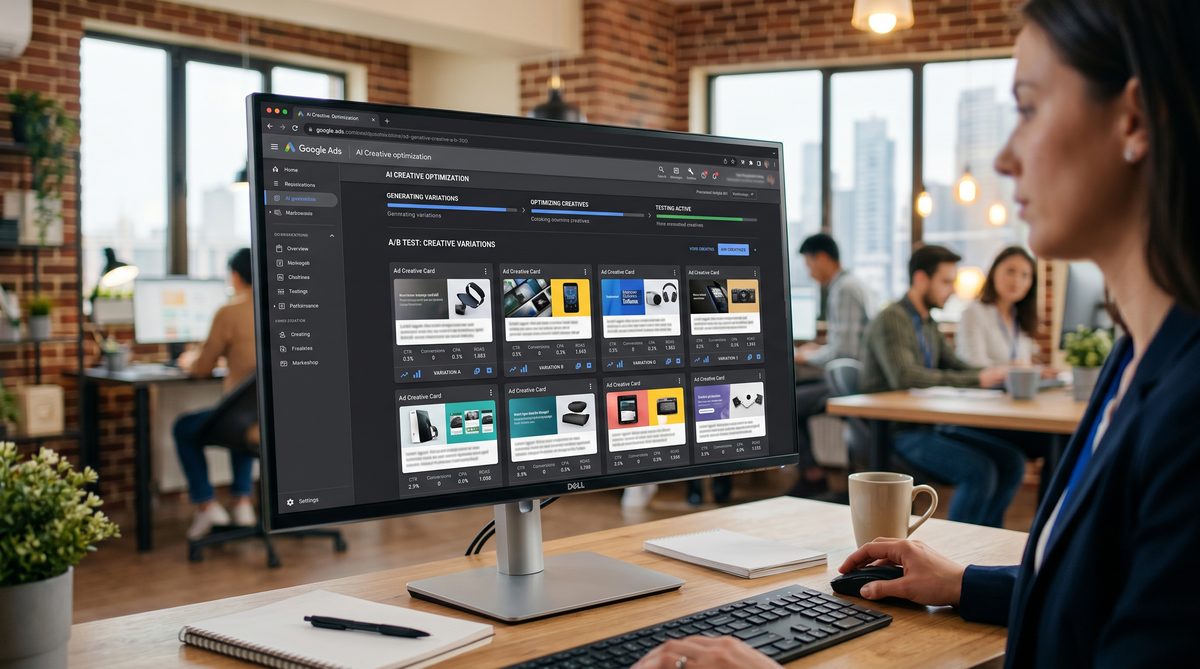
Testing velocity. This is the real value. AI Max generates creative variations at a scale and speed no team can match manually. For accounts running A/B tests on messaging, AI Max compresses the feedback loop. You get signal faster.
Broad query coverage. Campaigns using AI Max with the full feature suite see an average of 14% more conversions at a similar CPA/ROAS, according to Google’s own data. For exact and phrase match campaigns converting to AI Max, the figure can reach 27%.
DSA replacement. Dynamic Search Ads required a well-structured website for the algorithm to crawl and generate ads from. AI Max extends that coverage while adding better targeting intelligence. For accounts running broad informational queries, this is a meaningful upgrade.
New entrants with limited creative depth. If you are launching a new campaign and do not have six months of creative testing data to draw from, AI Max gives you a starting point. The AI learns faster than most teams iterate manually.
Cost-per-resolution drops are real at scale. BYD used text guidelines within AI Max to maintain brand standards while scaling AI-generated creatives, reporting a 24% increase in leads at a 26% lower cost. That outcome is achievable. It is also not guaranteed.
Where It Breaks
The black box problem. AI Max operates with limited transparency. Broad match expansion pushes ads beyond your keyword list into territory you did not specify. Final URL expansion sends users to pages you didn’t choose. Your ad copy gets rewritten. When performance drops, diagnosing the cause requires reversing through decisions the AI made without telling you.
Creative drift. A system generating ad copy needs concrete qualitative direction. AI Brief helps — but only when the instructions are specific. Vague briefs produce generic copy. Generic copy performs like generic copy. The advertisers who see AI Brief work are those who treat it like a creative director briefing session, not a checkbox.
Budget waste from irrelevant matches. Reports cite up to 15% spend inefficiency from irrelevant query matches despite promised reach boosts. This is the gap between the AI optimizing for conversion signal and the operator’s knowledge that some conversions are low-quality. The algorithm does not know what you know about your buyer quality. You have to encode that knowledge through negative keywords, audience signals, and text guidelines.
Compliance and data exposure risk. The gap between what Google’s AI does and what account managers control is wider than many realize. That gap has a cost in compliance risk and data quality that does not show up in the conversions column. Industries with regulatory constraints — healthcare, finance, legal — need explicit governance protocols before activating full AI Max.
The September 2026 forced upgrade. DSA campaigns that auto-upgrade inherit the most aggressive AI Max configuration by default — all three features active. Advertisers who are not ready for AI to generate creative, match broader queries, and route to expanded landing pages need to voluntarily migrate before September to configure features per campaign. This is not a recommendation. It is a damage control deadline.
The FOCUS Strategy Applied to AI Max
The FOCUS Strategy is the framework I use when evaluating any automation system for operator deployment. It keeps the team from confusing capability with strategy.
F — Foundation First. Before activating AI Max, clean what the automation depends on: Merchant Center feeds if shopping is involved, landing page quality, conversion tracking accuracy, negative keyword lists. Automation amplifies your inputs. Bad inputs at scale produce bad outputs at scale.
O — Objectives Over Features. What is the campaign goal? Conversion volume, ROAS, lead quality, brand awareness? AI Max serves different objectives differently. The operators who get burned are those who activate all features because the feature exists — not because it serves the objective.
C — Control Architecture. Text guidelines are your primary brand safety lever inside AI Max. As of February 2026, text guidelines are available to all advertisers globally — up to 25 term exclusions for specific words, up to 40 messaging restrictions for tone and concept. Configure these before launching. This is the standing order to the automation layer.
U — Understand the Failure Path. Run AI Max on a subset of campaigns first. Monitor query reports weekly. Identify the irrelevant match patterns before scaling spend. The casualty drill happens before the patrol, not during.
S — Supervisor Loop. AI Max is not a set-and-forget system. It requires a human supervisor operating as an orchestrator — reviewing performance against objective, feeding negative keywords, updating AI Brief guidance based on what the AI produces, and making judgment calls the algorithm cannot.
The Operator’s Verdict
AI Max beats manual testing velocity. AI Max loses to a disciplined operator when the judgment calls matter.
Use AI Max for: campaigns where broad query exploration adds value, accounts with clean data and well-structured landing pages, creative testing where you need signal quickly, and campaigns transitioning off DSA before the September forced upgrade.
Do not use AI Max as: a replacement for audience knowledge, a solution to weak creative strategy, or a substitute for understanding what drives buyer quality in your specific market.
Marketing Brew noted in its April 30, 2026 coverage that Google is pushing automation further into the marketing process. That direction is not reversing. The operators who win are not the ones who resist automation — they are the ones who learn to guide it effectively through concrete signals, maintain supervisory oversight, and never confuse the automation handling routine operations with the automation handling judgment.
The reactor plant automated safety systems on a submarine could handle everything in the design envelope. The watchstander existed for everything outside it. Your team is not being replaced. They are being promoted to watchstander.
Doctrine Connection
Process beats ego. The operators who get the worst results from AI Max are those who either refuse to engage with it (ego protection of the old process) or hand it full control without building the supervisory system around it (ego-driven faith in the new one). Process means building the control architecture — text guidelines, negative keywords, objective-first configuration, supervisor review cadence — before scaling spend. The process is what keeps the automation in the design envelope.
Frequently Asked Questions
Q: What is Google AI Max for Search campaigns? Google AI Max for Search is an automation suite that bundles search term matching (broader query coverage), text customization (AI-generated ad copy), and final URL expansion (AI-chosen landing pages) into a single campaign setting. It reached general availability on April 15, 2026. Dynamic Search Ads will auto-upgrade to AI Max in September 2026.
Q: What is AI Brief and how does it work? AI Brief is a natural-language tool within AI Max that lets advertisers provide guidance on brand tone, messaging preferences, and audience targeting before the AI generates creative. Advertisers write instructions — concretely, not vaguely — and AI Max uses those guidelines when generating ad variations and making targeting decisions.
Q: What are the biggest risks of using Google AI Max? The primary risks are: loss of creative control and brand voice drift from vague or absent text guidelines; budget waste from irrelevant query matches (reported up to 15% spend inefficiency); compliance gaps in regulated industries; and performance degradation when the inputs the AI depends on — feeds, landing pages, conversion tracking — are not clean.
Q: Should I upgrade my DSA campaigns to AI Max before September 2026? Yes. Voluntary migration before September lets you configure individual AI Max features per campaign — choosing which of the three automation layers to activate. The September auto-upgrade applies the most aggressive configuration by default. Proactive migration preserves control.
Q: How do I measure whether AI Max is working? Track conversions and ROAS as primary metrics, but also monitor search term reports weekly for irrelevant match patterns, review AI-generated ad copy against brand guidelines, audit landing page routing through final URL expansion, and measure lead quality — not just lead volume. The algorithm optimizes for conversion signals; you validate that those signals reflect real buyer quality.
Sources
- Marketing Brew — Google rolls out new tools to automate even more of the marketing process (April 30, 2026)
- Google Blog — Unlock next-level performance with AI Max for Search campaigns
- Google Ads Help — About AI Max for Search campaigns
- Google Business — Dynamic Search Ads are upgrading to AI Max
- ALM Corp — Google AI Max New Features: AI Brief, Shopping Expansion, Travel Campaigns
- Digital Applied — Google AI Max PMax: Brand-Safe AI Ad Controls
- Astha Technology — Google AI Max 2026: Risks, Trends and Advertiser Control
- Groas — Google Ads AI Max For Search In 2026: Complete Setup, Real Performance Data
- Search Engine Journal — Google Launches AI Max For Shopping and Travel Campaigns