
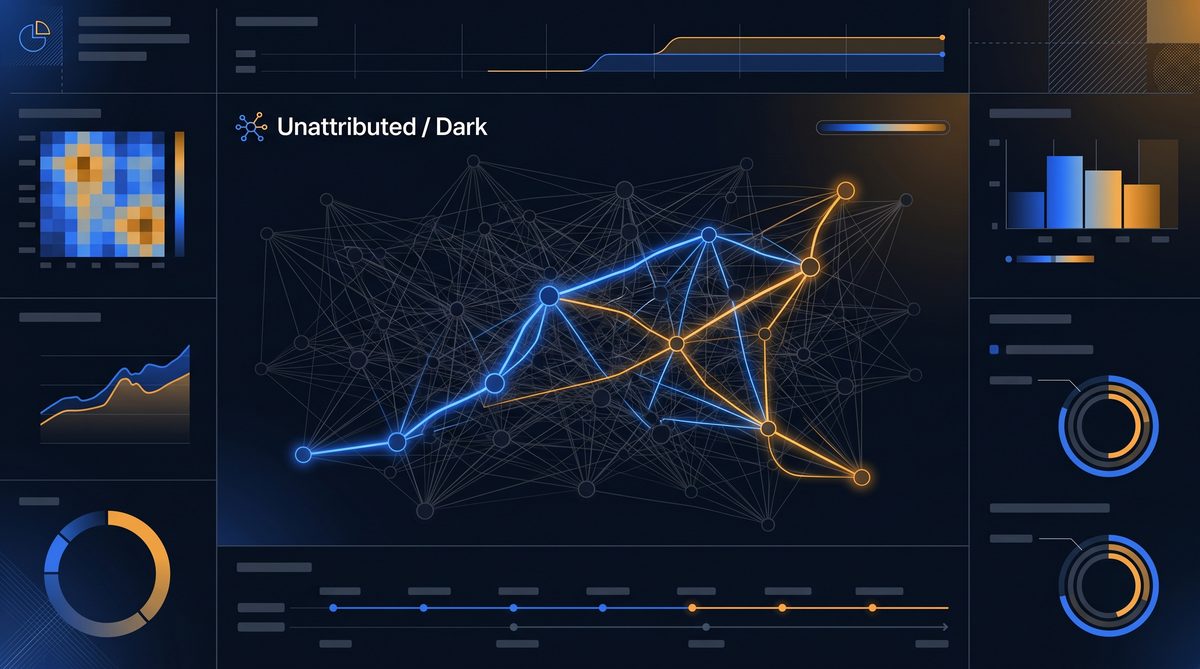
The Attribution Blindspot Nobody Talks About
GA4 reports direct traffic. Your customer feedback reports LinkedIn, Slack DMs, podcasts. The gap between what your analytics claims and what actually moves pipeline? Up to 90 percent.
This isn't a software problem. It's an architecture problem. Analytics can only see what lives in trackable channels. When a prospect hears your founder on a podcast, Googles your company three weeks later, and lands on your site, that's direct traffic. Podcast credit? Gone.
Digital Applied surveyed 1,200+ B2B teams in 2024-2026. The finding: 38% of pipeline remains unattributable. Thoughtlytics research shows 80% of the B2B buying journey happens in dark channels—Slack threads, WhatsApp forwards, Zoom recommendations, private Discord communities. Prospectory's data: 70% of the buyer journey is invisible to standard attribution tools.
These aren't theoretical gaps. When one SaaS founder cut podcast sponsorships based on their attribution dashboard showing zero ROI, revenue tanked 40% within six months. The pipeline was real. The measurement was just silent.
This is the cost of crediting nothing for the channels that close deals.
Why Direct Traffic Is a Lie Your Dashboard Tells
Direct traffic is a category. Not a channel.
It's the bucket for behavior your software cannot explain. Someone typing a URL from memory, clicking a bookmark, pasting a link from Slack into their browser—all direct. But they only know your company exists because:
- They saw your name dropped in a Slack community last month. - A peer sent them your guide via email. - They heard a 90-minute interview with your CEO on a podcast. - A comment on a LinkedIn post caught their eye.
None of this is "direct." It's the dark funnel.
Prospectory's real case: A demand gen team added one open-text field to their demo request form: "How did you first hear about us?" Within month one, 23% of respondents named a specific podcast. Those leads had been credited to organic search or direct traffic. The measurement gap was real. The fix was a form field and an hour of analysis.
GA4 can't solve this problem because it's not a tracking problem. It's a visibility problem. You need measurement outside the pixel, not inside it.
The Four-Tool Stack: Recapturing 30-40% of Dark Social Pipeline
Building defensible dark social attribution requires four inputs working in parallel.
1. Open-Text Survey Capture
Add this field to your demo request, contact form, and onboarding surveys: "How did you first hear about us?" Make it optional but visible. Don't offer dropdown presets—let customers write their own story. Slack, podcast name, LinkedIn, friend recommendation—you'll get specificity your analytics never gave you.
Data point: Self-reported attribution recovers 23-30% of pipeline that GA4 misses. This is real customer intent, stated by the person who made the buying decision. Weight this signal heavily.
2. Win/Loss Interview Attribution
Your sales team already talks to won accounts and churned customers. Train them to ask: "What was your first exposure to us?" and "What made you remember us?" within the sales process. Document patterns by cohort (industry, company size, deal size) to see which dark channels drive qualified pipeline.
Win/loss attribution is slower than form data but more accurate. One strong pattern (e.g., 40% of your Enterprise segment comes from industry podcasts) is worth more than vanity metrics.
3. Unified Analytics Layer for Digital Channels
Owncloud your analytics via CDP or data warehouse. Ingest form submissions, web analytics, email engagement, and CRM stage progression into one fact table. Build custom dashboards that ask: Of all MQLs that came from organic, how many mentioned Slack, podcasts, or LinkedIn when asked directly?
This unification reveals the true path. Example query: Organic traffic + Demo form mentioning podcast = Dark social podcast pipeline = real attribution credit.
4. First-Party Data Enrichment in CRM
Don't rely on source codes or UTM parameters. When a form submission mentions a dark channel, tag the lead in your CRM immediately. Create a custom field: "Self-Reported Channel." When this field matches pipeline outcomes, you're building evidence that dark social matters.
GHL and HubSpot both support custom fields and workflows. Use them. Track leads with dark-channel attribution separately from your standard pipeline, and measure conversion rates by cohort.
The Survey Methodology: How to Do This Right
This isn't guesswork. It's structured evidence collection.
Start small: One form, one question, two weeks of data. Ask "How did you first hear about us?" on your demo request form. Don't lead responses. Let customers type freely. You'll see patterns immediately.
Week one takeaways typically include:
- 40-50% mention a single dark channel (podcast, Slack community, peer recommendation). - 20-30% mention another dark channel as a secondary touchpoint. - 10-15% mention tracked channels (paid ads, organic search). - Small percentage mention company recommendation or brand recall.
The math reveals the measurement gap. If your analytics says organic drove 60% of traffic but only 10% of respondents mention organic as first touch, you've found the blindspot.
Scaling the methodology: Once you've validated the pattern on one form, add the same question to your contact form, onboarding survey, and sales qualification stages. Track it for 90 days minimum. Build cohort analysis by company size, industry, and deal stage. Measure conversion rates for dark-channel sources against tracked channels.
Data's DNA Framework applies here: You're building verification (customer-stated attribution), not just guesses (pixel tracking). You're measuring patterns across cohorts, not one-off anecdotes. You're creating records in your CRM that downstream teams can act on.
GHL and HubSpot Implementation
GoHighLevel and HubSpot are built for this. Here's how to wire it.
In HubSpot:
1. Add a custom contact property: "How did you hear about us?" Type: Text. Set as optional. 2. Create a workflow: When form submission includes the field, set the property immediately. 3. Create another workflow: When a deal is won and the contact property is filled, create a custom report dashboard showing won deals by source. 4. Build a view in your Deals object filtered by custom property. Track conversion rate (Deals Won / Total Leads) for each source.
Usage: Your sales team now sees which contacts arrived via dark channels. When deal probability increases from prospects mentioning podcasts, the CRM shows it. Attribution credit shifts from generic "organic" to "podcast, company X."
In GHL:
1. Add a custom field to your contact schema: "First Heard About Us" or "Attribution Source." 2. Create a workflow: On form submission, trigger a tag based on the response (e.g., if response contains "podcast," tag with "source_podcast"). 3. Route tagged contacts into a secondary nurture sequence specific to their source. Podcast prospects get your podcast Q&A guide. Slack mentions get a Slack-specific case study. 4. Create custom reports: Segment your pipeline by tag. Track which sources drive the most meeting bookings, SQLs, and wins.
Both platforms can push this data to Google Sheets or a data warehouse for monthly analysis. The key: Act on the data. Don't just collect it.
Measuring Dark Social Attribution Results
How do you know the system is working?
Week 4: Your form data shows 50%+ of respondents mention dark channels. Baseline achieved. Your dashboard is seeing the truth your analytics missed.
Week 12: Conversion analysis shows deals from podcast mentions convert 15% higher than generic organic. This is now quantified. Your CEO will listen.
Month 6: Win/loss interviews reveal 60% of Enterprise segment comes from industry podcasts, 25% from Slack communities. Budget allocation shifts. Podcast spend increases because now you have measurement.
Month 12: Quarterly review shows 30-40% of attributed pipeline now maps to dark channels instead of sitting in "direct traffic" purgatory. This is the recapture. Visibility creates accountability. Accountability drives better strategy.
The system works when what your dashboard claims and what your sales team observes finally align.
A Navy Intel Parallel
Early in my time advising on growth operations, I worked with a former Naval intelligence officer running demand gen for a $5B platform business. He described his old work this way: "In the field, we could see the enemy on radar. But 40% of the real activity happened in channels radar couldn't reach—human assets, signal intelligence from sources, reports from allies. If we only acted on what the radar showed, we'd lose." His advice: "Build a second measurement system. Verify what the primary system shows. Cross-reference." That's dark social attribution. GA4 is your radar. Customer-stated attribution is your human intelligence. Neither one is truth alone. Together, they are.
For more on this, see our piece on the B2B SaaS content engine.
For more on this, see our piece on winning AI Overviews.
For more on this, see our piece on the AI-First NRR Playbook.
FAQ
Q: Isn't self-reported attribution biased? A: Not if you structure it right. Customers remember how they discovered you because the discovery was intentional. They didn't accidentally stumble into your demo request. They chose to. Self-reported attribution for this choice is more reliable than pixel tracking of accidental visits. Compare: form submission (intentional, high value) vs. traffic spike from a Reddit mention (high volume, low intent). You want the former.
Q: How do I prioritize which dark channels to measure first? A: Start with the three your sales team mentions most: podcasts, LinkedIn, and Slack communities. After 90 days, your form data will show which is actually highest. Then optimize spend accordingly. Evidence beats assumption.
Q: What if my closed deals say dark social, but my boss demands "proof"? A: Interview your last 20 closed-won deals. Ask how they heard about you first. If 12 say "podcast" or "Slack," that's 60% dark-sourced pipeline. Document it. Show the win/loss interview notes to your executive team. This is proof. It's not pixel-based attribution, but it's more defensible than a GA4 dashboard that shows zero podcast credit.
Q: Do I need to rebuild my entire attribution model? A: No. Run dark social measurement in parallel with your existing model. Don't replace, supplement. In three months, you'll see which system tells the real story. Then decide.
Doctrine Connection: Verification beats optimism. Don't assume your attribution dashboard tells the truth. Build a second measurement system and verify against it. Dark social attribution reveals what your analytics was hiding.