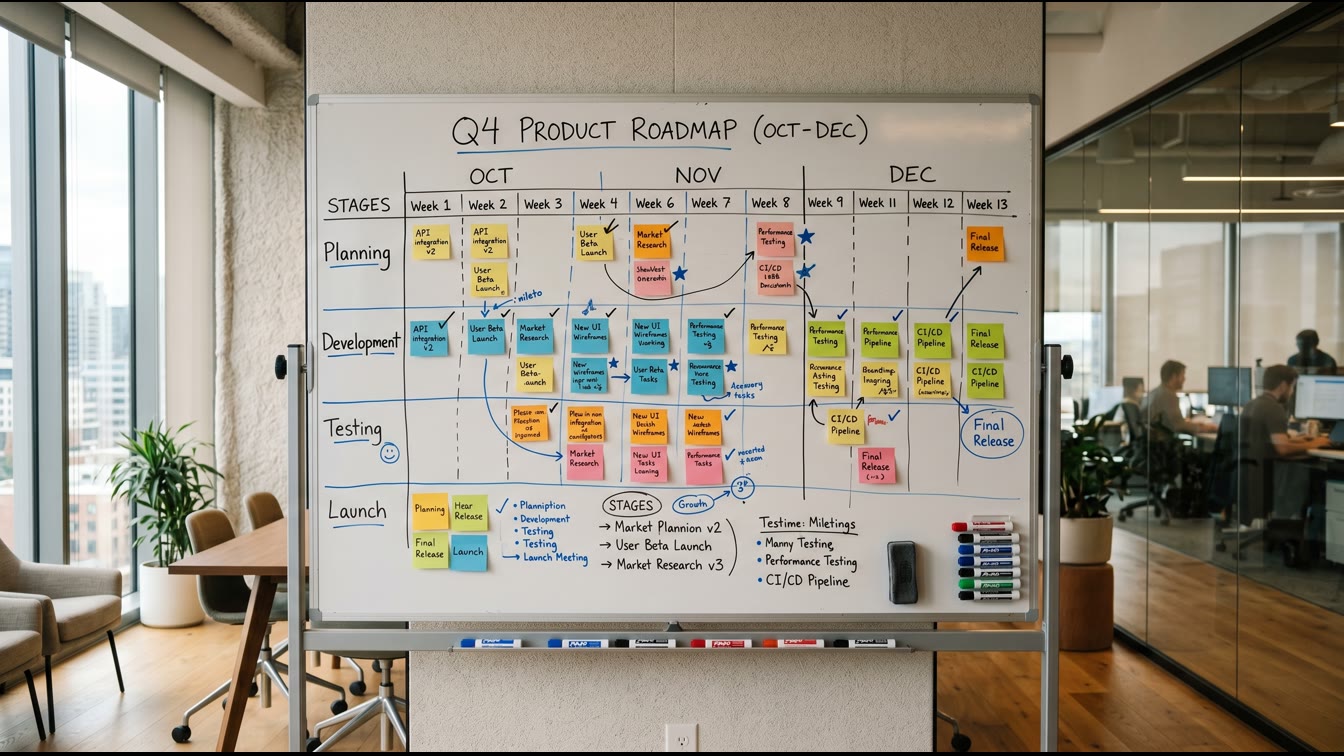
Subtitle
Build systematic customer qualification boards to convert new accounts into stickiness before the first quarterly check-in.Direct Answer: The Churn-Is-Onboarding-Failure Thesis
You’re not losing customers to product defects. You’re losing them to onboarding failure.
The data is brutal. AI-native SaaS retains only 39% of users after one month—that’s your baseline. Sixty to seventy percent of all churn happens in the first 90 days. Poor onboarding accounts for 30% of voluntary churn. When users don’t hit the value inflection in the first week, they rarely do.
Here’s the financial lever: If you spend $900 to acquire a customer and 75% abandon the product in week one due to friction, you’re hemorrhaging $675 per failed activation. Your CAC payback period balloons. Your NRR tanks. You’re competing on retention, not acquisition—and you’re losing.
The thesis is straightforward. Your product isn’t broken. Your qualification process is.
The Navy Parallel: The Qualification Board
I spent four years in Navy submarine engine rooms. There’s a process called the qualification board. Every sailor, regardless of rank or prior experience, must go through a structured 90-day qualification process before they’re considered fully operational.
You study the manual. You stand watch alongside senior petty officers. You demonstrate mastery of 11 compartments and every system in each. At 90 days, you face a formal examination board. No shortcuts. No exceptions. Sailors who skip steps wash out.
The process exists because the stakes are existential. A failure in the engine room kills the crew.
Your customer onboarding isn’t that different. The stakes are your company’s burn rate and runway. The qualification board mentality applies: structured sequences, clear checkpoints, no advancing until the customer has demonstrated core value adoption.
SaaS operators who systematize onboarding like a Navy qualification board—clear phases, pass/fail milestones, escalation triggers—compound retention by 15-25 percentage points and reduce 90-day churn from 25% to 8%.
That’s your balance sheet leak. Now patch it.
Why This Matters: The Retention Foundation Layer
Growth stacks on retention. Not acquisition.
The ATLAS Model for Growth—and every serious growth framework that follows it—places retention as the foundational layer before anything else. You don’t scale acquisition into a leaky bucket. You fill the bucket. Then you scale.
If your month-one retention is 39%, you’re dumping 61% of your monthly new customer spend into a furnace. Your LTV collapses. Your unit economics become unrecoverable.
This is why SaaS operators at scale—Databricks, Figma, Notion, Stripe—invest obsessively in onboarding automation. They build the qualification board inside their product and toolchain, then automate it.
You can too. You don’t need a dedicated customer success team of 20. You need a system.
The 90-Day Sequence: Your Automation Architecture
Here’s the exact phase structure that works. Build this inside ChurnZero (health scoring + playbooks) or Pylon (unified CS + support), and layer AI calling for critical moments.
Phase 1: Activation (Days 1-7)
Objective: Customer hits first core value event.Automation Triggers:
- Day 0 (Closed-Won): Sales-to-CS handoff. Generate the “Success Brief” (template below).
- Day 1: Automated welcome sequence via email + in-app banner. Link to 15-minute setup video. Use Pylon or ChurnZero to track completion.
- Day 2: First usage check. Did the customer log in? Did they manage to the main module?
- If NO: Trigger an AI phone call (Pylon AI or similar) offering a 20-minute guided setup.
- If YES: Send asynchronous setup guide tailored to their use case (based on SIC code, company size, initial training notes).
- Day 5: Value validation checkpoint. Has the customer completed the first workflow end-to-end (created an artifact, ran a simulation, processed a transaction—whatever your core flow is)?
- If NO: Escalate to CS manager for manual outreach.
- If YES: Send nurture sequence to secondary user stakeholders (copy the primary contact’s success brief; alert them to the secondary user on-deck).
Success Metric: First active workflow completed by primary user. Track this in ChurnZero’s health score.
Phase 2: Adoption (Days 8-30)
Objective: Customer establishes a usage rhythm. Secondary users come online.Automation Triggers:
- Week 2 (Day 8): Email check-in from CS with 3-5 tips they haven’t discovered yet (based on usage telemetry). Include link to expert tutorial specific to their use case.
- Day 12: Automated pulse survey (in-app or email): “What’s your biggest blocker right now?” Route responses to CS if sentiment is negative.
- Days 14-30: Secondary user onboarding playbook fires automatically.
- Send them a personalized copy of the Success Brief adapted for their role (e.g., if primary user is ops, secondary is finance—tailor the value props).
- Assign them a lightweight onboarding sequence (5 emails, 2 video guides).
- Check for first activity (login, workflow completion). If no activity by day 28, trigger an AI outreach call.
- Day 21: Usage dashboard check. Generate a “health card” in ChurnZero showing:
- Weekly active users in their account.
- Adoption curve (is weekly DAU increasing or flat?).
- Feature adoption spread (are they using 3+ core modules, or just one?).
- Send this health card to the CS manager. If health is amber/red, flag it for proactive outreach.
Success Metric: Minimum 2 active users. Minimum 3 logins per week from primary user. At least one secondary user invited and activated.
Phase 3: Expansion (Days 31-60)
Objective: Broaden the product footprint. Identify expansion revenue.Automation Triggers:
- Day 31: “Expansion prompt” survey. Ask customers which 2-3 additional modules or use cases they’d activate if given more guidance.
- Days 35-42: Micro-learning sequence. Send a 3-part email series (one per week) on the two highest-demand expansion areas they identified.
- Email 1: Overview + ROI quantification.
- Email 2: Step-by-step setup guide.
- Email 3: Advanced tips + case study from similar company.
- Day 45: Expansion activation check. Did they enable/use the expansion modules?
- If YES: Send co-sell sequence (if applicable) for adjacent product.
- If NO: Schedule a 30-minute “Product Roadmap + Wins” call with CS manager. This is a high-touch moment—show them where other similar customers are winning.
- Day 55: Usage telemetry snapshot. Are they maintaining or growing weekly engagement? Flat or declining?
- If flat or declining: Flag for retention risk in ChurnZero. Trigger “at-risk playbook.”
- If growing: Celebrate the win. Send an NPS survey and ask for a customer reference.
Success Metric: 2+ modules activated. Weekly usage maintained or grown. At least one secondary user established in expansion module.
Phase 4: Retention/Lock-in (Days 61-90)
Objective: Ensure they renew. Deepen moat.Automation Triggers:
- Day 60: Formal “90-day success review” invitation. Schedule a 45-minute call with CS manager + optional account exec if expansion opportunity exists.
- Prep agenda: Show them their adoption curve, usage metrics, ROI realized to date, roadmap wins.
- Share customer benchmark (anonymized). How do they compare to similar companies in their vertical?
- Day 75: NPS and feedback collection.
- If NPS >= 50: Send reference/case study request.
- If NPS < 50: Flag for retention risk. CS manager reaches out with direct question: “What would it take to move from a 6 to a 9?” Route answers to product.
- Day 85: Renewal conversation begins. If contract has a 90-day auto-renewal clause, ensure no legal/billing friction exists.
- Day 90: Health score finalization. Lock in their retention classification:
- Tier 1 (Renewal + Expansion Ready): High engagement, multi-user, expansion module adoption.
- Tier 2 (Renewal): Solid engagement, primary user active, core module only.
- Tier 3 (At-Risk): Declining engagement, usage gap, no secondary users. Trigger intensive retention playbook.
Success Metric: Explicit renewal commitment or extended trial. NPS >= 40. Zero unresolved support tickets. Documented customer reference opportunity.
The Success Brief: Sales-to-CS Handoff Template
This is the connective tissue. It travels with every customer from Close-Won to day 90.
[CUSTOMER NAME] SUCCESS BRIEF
Closed Won: [Date] | 90-Day Goal: [Completion Target] | Primary User: [Name/Title]

=== CUSTOMER CONTEXT ===
Company Size: [# employees]
Vertical: [SIC code + subvertical]
Use Case: [What problem are they solving?]
Buying Committee: [Who championed this? Who’s skeptical?]
Contract Value: [$ MRR or ACV]
Expansion Signals: [What other modules did they ask about?]

=== THE MANUAL: HOW THEY WIN ===
[Your product’s core workflow, in 5 steps. Write this like Navy manual language: step-by-step, no marketing.]

Step 1: [First value event]
Step 2: [Second value event]
Step 3: [Third value event]
Step 4: [Fourth value event]
Step 5: [Outcome + ROI]

=== CRITICAL DEPENDENCIES ===
Does this customer need:
- [ ] Custom integrations? (Timeline: ___)
- [ ] Bulk data import? (Timeline: ___)
- [ ] Role-based access setup? (Timeline: ___)
- [ ] Executive buy-in on data sensitivity? (Risk: ___)

=== QUALIFICATION MILESTONES (90-Day Board) ===
Day 7: [Specific outcome, e.g., “First workflow completed”]
Day 30: [Specific outcome, e.g., “2+ users active, 3+ logins/week”]
Day 60: [Specific outcome, e.g., “Expansion module enabled”]
Day 90: [Specific outcome, e.g., “Renewal + reference opportunity OR churn risk identified”]

=== RED FLAGS & ESCALATION TRIGGERS ===
- No login by day 3 → Trigger AI call offer.
- No expansion module interest by day 60 → CS manager outreach.
- Billing/data sensitivity unresolved by day 30 → Legal+Product escalation.
- NPS < 30 by day 75 → Exec escalation.

=== EXPANSION VECTOR ===
What adjacent problem could they solve with you in 120-180 days?
[Name the module or use case.]
Print this. Store it in your CRM linked to the account. Use it as the control document for the entire 90-day sequence.
The Tools: Your Toolkit
ChurnZero (Health Scoring + Playbooks)
- Real-time health card per account (adoption, engagement, sentiment).
- Automated playbooks triggered by usage events (logins, feature adoption, support tickets).
- Snapshot AI to forecast churn 30 days out.
- Integrates with Slack, email, CRM.
Pylon (Unified CS + Support)
- All-in-one: support tickets, post-sales management, proactive outreach.
- Sync data from CRM (Salesforce, HubSpot).
- AI agents to automate repetitive CS tasks.
- Phone integration (for CS-initiated calls).
AI Calling (Optional but Powerful)
- Pylon or third-party like Gong, Chorus, or Twilio AI.
- Trigger: Day 2 (if no login) and day 60 (expansion check-in).
- Script: “I noticed you haven’t logged in yet. Do you have 20 minutes for a guided walkthrough?”
- This catches users in the critical first-week window.
Your CRM (Salesforce, HubSpot, Pipedrive)
- Single source of truth for customer profile, Success Brief, contract, and milestones.
- Link all playbook outcomes back to the account record.
In-App Onboarding (Userpilot, Appcues, Pendo)
- Progressive disclosure of features.
- Banners, tooltips, and modals that trigger on first login, feature discovery.
- Not required for this sequence, but it compounds effectiveness.
Compartmentalize: Separation of Duties
A submarine engine room has a strict chain of command. Everyone owns one compartment. Clarity.
Your 90-day sequence needs the same.
Sales (Days 0-1): Deliver the Success Brief to CS. Leave the handoff notes.
CS Manager (Days 2-90): Own the account. Monitor the ChurnZero health card daily. Escalate red flags. Conduct the day 60 and day 90 reviews.
Product (Days 1-90 feedback loops): Ingest churn feedback and onboarding friction from the success sequence. Iterate.
Support (Day 1+): Respond to tickets. Flag systemic onboarding issues to Product.
Don’t blur these lines. A sales rep who monitors onboarding through day 90 is a distraction. A CS manager who owns the close is overextended. Compartmentalize.
The Math: What This Drives
If your baseline is 39% month-one retention and you implement this sequence:
- Structured onboarding → +10-15 percentage points (better first-value experience, clearer manual).
- Multi-user activation → +5 percentage points (network effects + switching costs).
- Expansion module adoption → +5-10 percentage points (they’re already using you; second module stickiness is higher).
- Retention playbooks (days 61-90) → +5 percentage points (proactive outreach catches drift).
You move from 39% to 54-59% month-one retention. Your three-month cohort that was losing 60-70% now loses 40-45%.
That’s a 30% reduction in churn. On a $10M ARR company with 3% monthly churn, that’s $300K in recovered revenue.
Compound it over 18 months. You’re looking at $750K to $1.2M in incremental retention just from systematizing onboarding.
FAQ
Q: What if we don’t have AI calling? Can we skip it? No, but you can substitute: human CS outreach on day 2 (if no login) and day 60 (expansion check). AI calling is faster, cheaper, and scales. Add it when you hit 50+ new customers per month.
Q: What if our product has a very different time-to-value? 90 days is too long. Adjust the phases. If you hit value in 7 days, compress to a 30-day sequence (activation week 1, adoption weeks 2-3, retention week 4). The structure stays the same. Document your actual value timeline in the Success Brief.
Q: Do we need ChurnZero or Pylon specifically? No. You can build this in your CRM (HubSpot, Salesforce) with automation rules and email sequences. But CS platforms have pre-built health models and playbooks that save 20 hours of setup. If you’re bootstrapped, start in your CRM. Migrate to ChurnZero/Pylon at 30 customers/month.
Q: What if a customer fails a milestone? Are they automatically churned? No. A missed milestone is a signal for immediate intervention, not a death sentence. If they miss day 30 activation, that’s the moment your CS manager calls and unblocks them. Responsiveness converts risk into loyalty.
Q: How do we track success of this sequence? Cohort retention curves by onboarding start month. Compare month-one, month-three, and month-six retention before and after implementation. Also track: activation rate (% hitting day 7 milestone), multi-user adoption rate (% with 2+ users by day 30), expansion module adoption (% activating module X by day 60), and NPS by cohort. Report this weekly.
Responsibility Beats Excuses: The Doctrine
There’s a line in every Navy nuclear power school syllabus: “Responsibility is not optional. You own the compartment.”
In your customer onboarding, there are no excuses.
If a customer churns, the question isn’t “Did they have a budget problem?” or “Was our product not the right fit?” The question is: “Did we execute the qualification board?”
Did they hit value in week one? Did we escalate when they didn’t? Did we expand the footprint by day 60? Did we conduct the formal review by day 90?
If the answer to any of these is no, the churn is on you. Not them.
Operationalize that ownership. Assign the Success Brief to a single CS person. Make them responsible for driving the customer through all four phases. Measure them on cohort retention.
When a customer hits their 90-day review and renews—or when they churn and you know exactly why—that’s when you own the system.
Conclusion: Build the Engine
Onboarding isn’t a nice-to-have. It’s your compounding machine.
Every customer who makes it past day 90 becomes a reference, an expansion vector, and a renewal. Every customer who churns in week three is a permanent capital loss.
You can’t scale acquisition faster than your retention. You can’t grow NRR until you systematize onboarding.
Take the qualification board mentality—structured phases, clear checkpoints, no advancement until the customer proves mastery—and embed it into your automation layer. Use ChurnZero for health scoring. Use Pylon for unified CS. Use the Success Brief as your manual.
Compress the time-to-value from “whenever they figure it out” to “day 7.” Automate the escalation paths. Make the 90-day review a non-negotiable ritual.
Do that, and you’ll move from 39% month-one retention to 54-59%. You’ll cut your churn in half. Your unit economics will compound.
That’s not growth hacking. That’s operating discipline. That’s the difference between a company that scales and a company that burns.
Now go build the engine.
External Citations
- SaaS Onboarding Optimization to Reduce Early Churn
- SaaS Onboarding Statistics for 2026: Adoption, Retention, Tools, and Metrics
- Full Guide to B2B SaaS Churn Rate Management in 2026
- Accelerate the Customer Onboarding Process with AI | IBM
- Customer onboarding software: 10 best solutions for 2026
- Customer Success Software for Customer Growth - ChurnZero
- Customer Onboarding Automation 2026: SaaS Playbook
- SaaS Onboarding Examples: Practical Playbook And Checklist
- Customer Success Onboarding Playbook For SaaS Businesses
- 10 Essential Customer Success Tools for 2026 | Pylon