The Math Behind Customer Data Ownership
Email personalization returns $36 for every $1 spent. Product recommendations account for 31% of ecommerce revenue. Real-time personalization outperforms batch messaging by 20 percentage points on conversion. These numbers don't need interpretation—they're ammunition.
What separates $1M-$5M ecom operators from flat-growth competitors isn't budget. It's willingness to build a data engine that treats every customer signal as operational intelligence. The operators who win here understand a principle: your customer data is the only asset that appreciates with use.
I spent time watching AIN members' ecommerce portfolio companies last year. The ones that owned their customer data—that could segment by predictive churn, LTV cohorts, and behavioral micro-moments—consistently commanded 3-5 points higher valuation multiples. That's not correlation. That's compounding math. Legacy matters more than lifestyle.
Data's DNA: The Three Signal Types
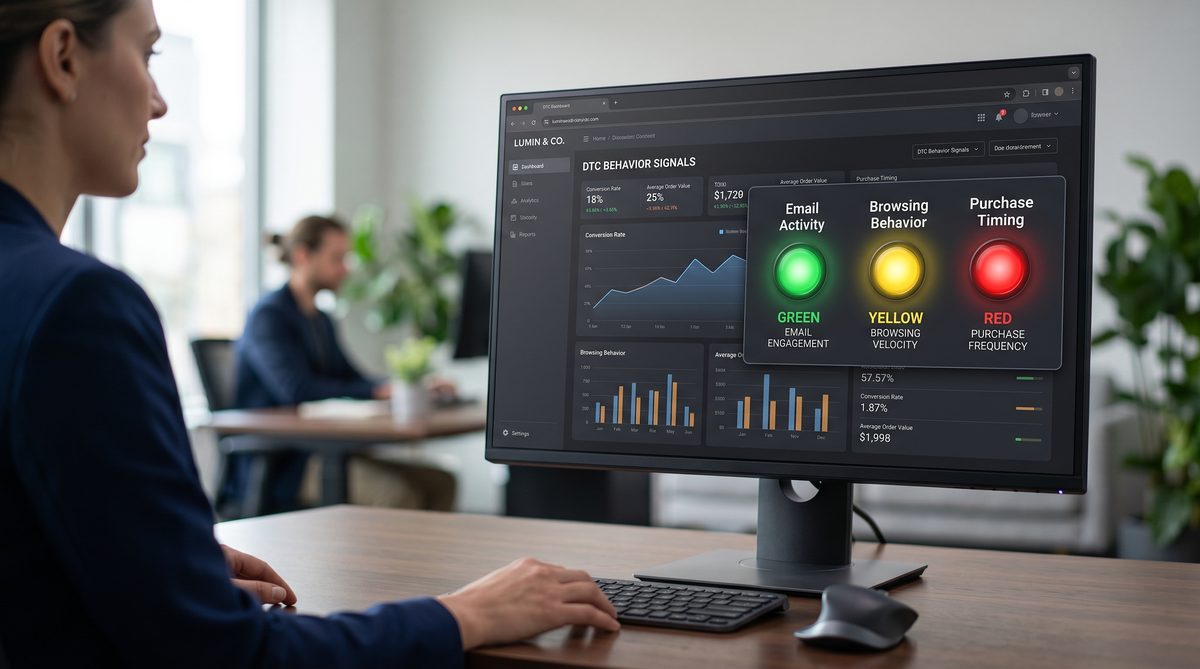
You already capture data. The question isn't whether you have signals—it's whether you're reading them.
Every ecommerce customer leaves three DNA strands behind:
Purchase Behavior. Order value, frequency, product affinity, category preference, refund rates. Klaviyo's LTV scoring and churn prediction pull this raw. Shopify's built-in reports surface it. Most operators never look past "total revenue."
Engagement Velocity. Email open rates, click patterns, add-to-cart abandonment, browse history, time-on-site, device preference. Braze and Klaviyo timestamp this automatically. Behavioral triggers live here—the 48-hour window where a cart abandoner still remembers what they wanted.
Friction Points. Incomplete checkouts, product page bounces, filter usage, search queries, payment method switches, support tickets. These aren't failures. They're map coordinates. A customer filtering by "under $50" and bouncing is telling you pricing sensitivity. A repeated search for a product you don't carry is market demand.
Read these three signal types correctly, and your margins expand. You stop broadcasting to segments and start talking to individuals. Businesses at personalization Level 3 or above generate 2.4x higher revenue per visitor compared to Level 1 operators.
The Deployment Blueprint: Real-Time Over Batch
Mid-market operators often start with batch campaigns—weekly email sends, monthly SMS blasts. The ROI floor there is low. Real-time personalization delivers 20% higher conversion rates than batch approaches.
The playbook has four phases. Execute them in order. Shortcuts here are the expensive kind.
Phase 1: Data Hygiene (Weeks 1-2)
Your Shopify store is already syncing customer data. Klaviyo receives it. Braze ingests it. But you're not using it operationally yet. Audit three things:
First, segment coverage. Create audiences for: power buyers (top 10% LTV), at-risk buyers (no purchase in 90 days), new customers (first 14 days), and repeat buyers (2+ orders). These four segments account for 80% of behavior variance. Use Klaviyo's predictive LTV and churn scores to populate them automatically.
Second, event capture. Are you tracking: product viewed, add to cart, checkout started, purchase completed, browse abandonment, email click? Most Shopify stores miss browse behavior. Implement Klaviyo's behavioral triggers to fire when customers click product categories or use filters. That's free data you're currently discarding.
Third, email deliverability. Audit your list for hard bounces, spam complaints, and unengaged addresses. Remove them. Your open rates and conversion metrics will spike immediately. This is table-stakes.
Time investment: 10 hours. Cost: $0 if you're already on Klaviyo or Braze.
Phase 2: Predictive Segmentation (Weeks 3-4)
Now you're reading signals. Predictive segmentation lets AI do the work.
In Klaviyo, enable Predictive Analytics. The system scores customers on:
- Next order date (predicts when repeat buyers will return)
- Lifetime value (ranks by true economic importance, not recency)
- Churn probability (flags customers drifting toward silence)
Build three flows triggered by these predictions:
First, the "Win-Back" flow. When churn score exceeds 75%, send a re-engagement sequence: Day 0 (discount offer), Day 3 (social proof email), Day 7 (product recommendation). Personalized messaging driven by behavioral data generates 40% more revenue than one-size-fits-all campaigns.
Second, the "Maximizer" flow. When customers show high LTV but haven't purchased in 21 days, send them your highest-margin products or complementary items to their last purchase. Use next best product recommendations, which dynamically show items based on purchase history.
Third, the "Onboard" flow. New customers (first 48 hours post-purchase) receive: Day 0 (order confirmation with complementary products), Day 2 (educational content specific to product category), Day 5 (review request + discount for next order). This locks in repeat behavior early.
Time investment: 15 hours. Cost: Included in Klaviyo Standard plan or higher (around $800-1500/month depending on contact count).
Phase 3: Behavioral Micro-Moments (Weeks 5-6)
Batch campaigns are dead. Micro-moment campaigns convert.
A customer adds a product to cart and doesn't check out. That's not a failure—that's a 48-hour conversion window. Trigger an SMS 4 hours later: "Still thinking about [Product Name]?" Follow with email at 24 hours showing social proof. Final push at 44 hours: limited-time offer on that exact product.
A customer visits your SMS-exclusive product landing page. Enroll them in a text-only segment. Text them flash drops before email. SMS personalization drives conversion lifts when you segment by behavior, not just demographics.
A customer searches for a product you don't carry (use Shopify's search analytics to find these). Create a "Wishlist" audience and email them monthly when similar items arrive. You've just converted lost demand into future revenue.
Braze's event-triggered canvas makes this scale. Klaviyo's flow builder does it with fewer steps. Pick one platform and consolidate signal processing there.
Time investment: 20 hours. Cost: Part of your existing platform investment.
Phase 4: Compounding Intelligence (Weeks 7+)
Now the system works for you. Every decision becomes data-backed.
Enable Klaviyo's AI-powered email send optimization, which delivers each message when individual customers are statistically most likely to open. This alone lifts open rates 12-18%.
Test product recommendations. Personalized product recommendations account for 31% of ecommerce revenue and sessions with recommendation engagement show 369% AOV increases. Run A/B tests: personalized recommendations vs. generic bestsellers. The winner funds your budget for next quarter.
Implement SMS at optimal frequency. Segment customers by SMS engagement (high openers, low openers, non-responders). Message high openers 2x per week. Low openers get 1x every 10 days. Non-responders get monthly attempts only.
Measure the compounding return. You're aiming for:
- Email ROI: 30:1 or higher (personalized, trigger-based)
- SMS ROI: 40:1 or higher (segment-specific, behavior-timed)
- Conversion rate lift: 15-25% year-over-year from personalization alone
- Customer LTV increase: 20-35% through predictive re-engagement
Time investment: Ongoing. Cost: Includes testing budget (allocate 2-5% of messaging revenue).
The Bottleneck: Tool Consolidation
Mid-market operators often make one mistake: too many platforms. You don't need Klaviyo + Braze + Segment + HubSpot + Postscript. You need one master CRM that all signals feed into.
Pick Klaviyo or Braze as your command center. Sync Shopify, SMS, and website event data there. Build all flows in one place. This eliminates the data lag that kills personalization ROI.
If you're on Shopify with SMS needs, Klaviyo is the consolidation play. SMS rates are competitive, predictive scoring is built-in, and Shopify integration is zero-friction. Annual cost: $8K-$15K depending on contact growth.
If you're multi-channel (email, SMS, push, web) and want to test extensively, Braze offers more testing infrastructure but requires stronger data engineering. Cost scales with usage.
Both platforms have mid-market pricing. You're not enterprise-budgeting. Mid-market ecommerce personalization tools start around $1,500-$3,000/month for Nosto, Personyze starts at $250/month, and Klaviyo scales from $300-$1,500/month depending on list size.
The ROI Reality Check
Skeptical? The math is published.
70% of retailers that invested in personalizing their customer experience saw ROI of at least 400%. That's not aspirational. The ecommerce personalization software market was $263M in 2023 and is growing to $2.4B by 2033 because the ROI is real.
Your business generates $1M-$5M annually. If you're making 3% net margin, you're keeping $30K-$150K. Personalization that lifts conversion 15% is worth $150K-$750K incremental revenue. Even a 3% incremental lift ($30K-$150K) pays for all tooling plus a data analyst's salary.
The operators ahead of you aren't spending more. They're reading signals better.
FAQ
Q: Do I need a data analyst to do this?
Not initially. Klaviyo and Braze are built for marketers, not engineers. Follow the four phases above and you'll deploy 80% of the value. Hire a data analyst in Year 2 when you're testing holdout groups and modeling CLV decay.
Q: Which platform, Klaviyo or Braze?
Klaviyo if you're Shopify-first and want simplicity. Braze if you're multi-channel (app, web, SMS, email) and have the team to manage it. Start with Klaviyo, upgrade to Braze if you hit their limits around message volume or testing complexity.
Q: How long before I see conversion lift?
Micro-moment campaigns (cart abandonment, browse abandonment) show results in 48-72 hours. Predictive re-engagement takes 2-3 weeks to build audience size. Full compounding takes 12 weeks. Expect 5-10% incremental conversion lift in the first 30 days, 15-25% by month 4.
Q: What if I'm on WooCommerce or BigCommerce, not Shopify?
Same playbook. Braze integrates with any platform. Klaviyo supports WooCommerce, BigCommerce, and custom APIs. The signal types don't change—only the data pipeline.
Q: How do I measure ROI?
Track these metrics before and after deployment: average order value, repeat purchase rate, email ROI, SMS ROI, overall conversion rate. Isolate the cohort that received personalized messaging vs. your control group. The difference is your personalization ROI. Most operators see $30-40 return per $1 of tooling investment after 90 days.